
News
CSO Accuses NNPCL GCEO of Sabotaging National Assets, Seeks Probe Of Kigali Retreat Scandal

A civil society organization, the Coalition of Nigerian Patriots for Good Governance, has reiterated its demand for the immediate removal of Bayo Ojulari, the Group Chief Executive Officer of the Nigerian National Petroleum Company Limited (NNPCL).
The coalition accuses him of orchestrating systemic sabotage of national assets and engaging in blatant abuse of office.
This announcement was made during a press conference in Abuja on Tuesday, led by National Coordinator Comrade Ibrahim Musa. He emphasized that the concerns raised by the coalition are shared by other civil society organizations, concerned workers, and transparency advocates who are alarmed by what they describe as the reckless actions of the NNPCL CEO.
They are accusing Ojulari of championing the following: the suspicious shutdown of Nigerian refineries; a grand plot to privatize and sell NNPCL to cronies; diversion of crude to illegal local refineries; mass resignations and a toxic work environment and; undermining the President’s national objectives.
The group demanded President Bola Ahmed Tinubu to immediately sack Bayo Ojulari as Group CEO of NNPCL; launch investigation into the ₦5.7 billion shady consultancy contract awarded under his leadership to Haske and for the EFCC to invite and probes all parties involved in the Kigali retreat scandal, including estacode fraud, use of five private jets, and outrageous waste of public funds.
The statement reads:“Barely weeks after his appointment, Ojulari’s leadership has been characterized by impunity, secrecy, and destructive policies that threaten to derail the gains of the Renewed Hope Agenda and frustrate the tireless efforts of Mr. President in repositioning Nigeria’s oil and gas sector for sustainable growth and economic recovery.”
“THE SUSPICIOUS SHUTDOWN OF NIGERIAN REFINERIES: “We question, in the strongest terms, the irrational and suspicious shutdown of our national refineries by Mr. Ojulari, barely 24 hours after he assumed office on May 24th, 2025.
“Let it be on record that millions of taxpayers’ money has been invested in the rehabilitation of the Port Harcourt, Warri, and Kaduna refineries, with several reports confirming that some of these refineries had started test-running and were functional. Yet, Mr. Ojulari, without recourse to stakeholders, and any official technical audit, allegedly ordered a shutdown of the facilities. This action is anti-people, anti-progress, and targeted at undermining President Tinubu’s goal of achieving energy self-sufficiency and reducing fuel imports.”
The coalition also alleged an attempt by Ojulari to deliberately devalue the NNPCL to pave the way for what it called a rushed and questionable privatisation process.
“It is now an open secret within the industry that Mr. Ojulari has an agenda to deliberately demarket NNPCL to justify a hurried and shady privatisation process. We have credible information that buyers have already been lined up — cronies and proxies — waiting to acquire our national oil assets at giveaway prices. In the event he fails to privatise, Mr. Ojulari’s backup plan is to (allegedly) fabricate a bloated repair cost and demand billions to ‘refix’ already working refineries. This is nothing short of economic sabotage and institutional capture.”
“This is a deliberate effort to sabotage the national refining effort and enrich private interests.This diversion must be investigated. We therefore call for an independent inspection by a team of credible, external engineers — including COREN and refinery experts — to verify the true operational state of the refineries and to determine if there was ever a genuine reason to shut them down.”
The group also emphasized what it described as a brain drain at the NNPCL under Ojulari’s leadership, citing the recent resignations of senior officials, including the Group Chief Operating Officer, Mr. Roland.
“Under Ojulari’s leadership style, NNPCL is bleeding talent. Over the past two weeks, several senior officials have resigned, including Group Chief Operating Officer, Mr. Roland, and other key department heads. Worse still, Ojulari (allegedly) frequently drops President Tinubu’s name, claiming he is untouchable and above scrutiny because he is “the President’s man.” This is not only false but also a disgraceful abuse of privilege. We know that President Tinubu is not a corrupt man and would never support or protect such conduct.”
The coalition warned that the NNPCL’s current trajectory was undermining national economic objectives.
“It is on record that President Tinubu has made it a national priority to raise Nigeria’s crude production from 1.6 million barrels per day to 3 million barrels per day. However, under Ojulari’s command, NNPCL is headed in the opposite direction — from transparency to secrecy, from performance to decay. Ojulari’s mismanagement is clearly undermining the bold reforms and credible image President Tinubu is trying to build both locally and internationally.”
In response, the coalition issued a series of demands to the Presidency and relevant authorities:
“We call on President Bola Ahmed Tinubu to immediately sack Bayo Ojulari as Group CEO of NNPCL. His continued stay in office is a threat to Nigeria’s energy security, oil sector reform, and economic recovery. We demand a full investigation into the ₦5.7 billion shady consultancy contract awarded under his leadership…
“We demand that EFCC invite and probe all parties involved in the Kigali retreat scandal, including estacode fraud, use of five private jets, and outrageous waste of public funds.
“We request the intervention of the National Assembly and COREN to immediately launch an independent technical audit of the nation’s refineries and expose the lies surrounding their shutdown.
“We urge the presidency to clean up the NNPCL, restore staff morale, and bring back professionalism, transparency, and patriotism.”



News
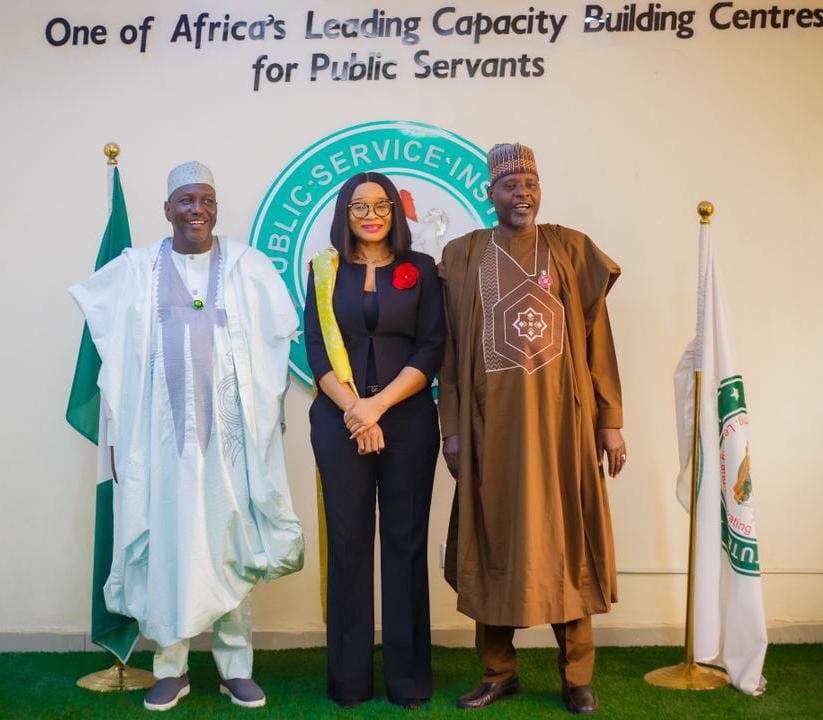
PSIN Posts Major Institutional Reforms, Improved Financial Discipline, Earns House Committee Praise
Cyril Ogar
The House of Representatives Committee on Public Service Matters has reviewed the 2024 budget performance of the Public Service Institute of Nigeria (PSIN) and commended the Institute’s leadership for initiating wide-ranging reforms aimed at strengthening governance, service delivery, and institutional discipline.
The commendation came during an oversight visit by members of the Committee to PSIN headquarters along the Kubwa Expressway, Abuja.
Speaking at the engagement, Chairman of the Committee, Hon. Engr. Sani Umar Bala, described the visit as significant, noting that it marked the Committee’s first official engagement with PSIN under the leadership of its new Administrator. He congratulated the Administrator on the appointment and expressed the Committee’s readiness to work closely with the Institute to promote accountability, innovation, and sustainable institutional growth.
Hon. Bala recalled that the Committee’s last oversight visit to PSIN took place in July of the previous year, during which key recommendations were made, particularly the need for the Institute to evolve innovative strategies to boost its Internally Generated Revenue (IGR) and the enactment of a substantive Establishment Act to strengthen its legal and institutional framework.
He stressed that all public funds, including IGR, must be expended strictly in accordance with constitutional provisions, legislative approvals, and national priorities, adding that oversight by the National Assembly is constructive and aimed at supporting institutions to perform better.
“This visit provides an opportunity for us to receive a clear account of actions taken since our last engagement, the reforms introduced, challenges encountered, and the strategic direction the Institute is now pursuing,” the Committee Chairman said.
In her address, the Administrator of the Public Service Institute of Nigeria Administrator/ CEO, Barrister Imeh Okon welcomed members of the Committee and described the visit as timely, coming shortly after the completion of his first 100 days in office. He explained that the period was deliberately focused on understanding the institution, engaging staff, and restoring operational discipline rather than publicity.
According to her, management instituted monthly whole-of-staff engagement forums, reinstated weekly departmental meetings, and introduced staff morale initiatives aimed at strengthening teamwork, accountability, and a sense of belonging.
On service delivery, Barrister Imeh Okon disclosed that PSIN successfully completed the onboarding of its Computer-Based Test (CBT) Centre as an accredited facility by the Joint Admissions and Matriculation Board (JAMB), strengthening the Institute’s capacity to deliver technology-driven and credible assessments.
Shee added that over 400 public servants from various Ministries, Departments and Agencies (MDAs) were trained during the period, while PSIN also conducted nationwide promotion examinations for more than 2,600 staff of the Independent National Electoral Commission (INEC) across the 36 states and the Federal Capital Territory.
The Administrator further highlighted steps taken to restore financial discipline, including strengthened financial controls, compliance with government financial regulations, comprehensive audits of facilities and assets, and the recovery and regularisation of outstanding revenues, all aimed at promoting transparency and value for money.
Physical infrastructure improvements were also recorded, with renovated lecture rooms, rehabilitated facilities, improved sanitation systems, fumigation of the premises, and enhanced security measures to protect government assets.
Looking ahead, he outlined plans to modernise PSIN’s curriculum, expand e-learning and blended learning platforms, digitise internal processes, and fully embrace the Institute’s think-tank mandate through policy dialogues, advisory services, and strategic partnerships, including a proposed twinning arrangement with the Singapore Public Service Institute.
The highlight of the visit was the presentation of PSIN’s 2024 budget performance, in line with the Institute’s core mandate of training and continuous retraining of public servants.
Members of the Committee welcomed the presentation and reaffirmed their commitment to supporting PSIN through legislation, policy guidance, and advocacy aimed at strengthening Nigeria’s public service architecture.
-
 Featured6 years ago
Lampard Names New Chelsea Manager
-
 Featured6 years ago
FG To Extends Lockdown In FCT, Lagos Ogun states For 7days
-
 Featured6 years ago
Children Custody: Court Adjourns Mike Ezuruonye, Wife’s Case To April 7
-
 Featured6 years ago
NYSC Dismisses Report Of DG’s Plan To Islamize Benue Orientation Camp
-

 Featured4 years ago
Transfer Saga: How Mikel Obi Refused to compensate me After I Linked Him Worth $4m Deal In Kuwait SC – Okafor
-
Sports3 years ago
TINUBU LAMBAST DELE MOMODU
-

 News12 months ago
Zulu to Super Eagles B team, President Tinubu is happy with you
-
Featured6 years ago
Board urges FG to establish one-stop rehabilitation centres in 6 geopolitical zones