
Foreign news
Nigeria Bolsters South–South Cooperation with High-Level Strategic Engagement in Trinidad and Tobago
Cyril Ogar
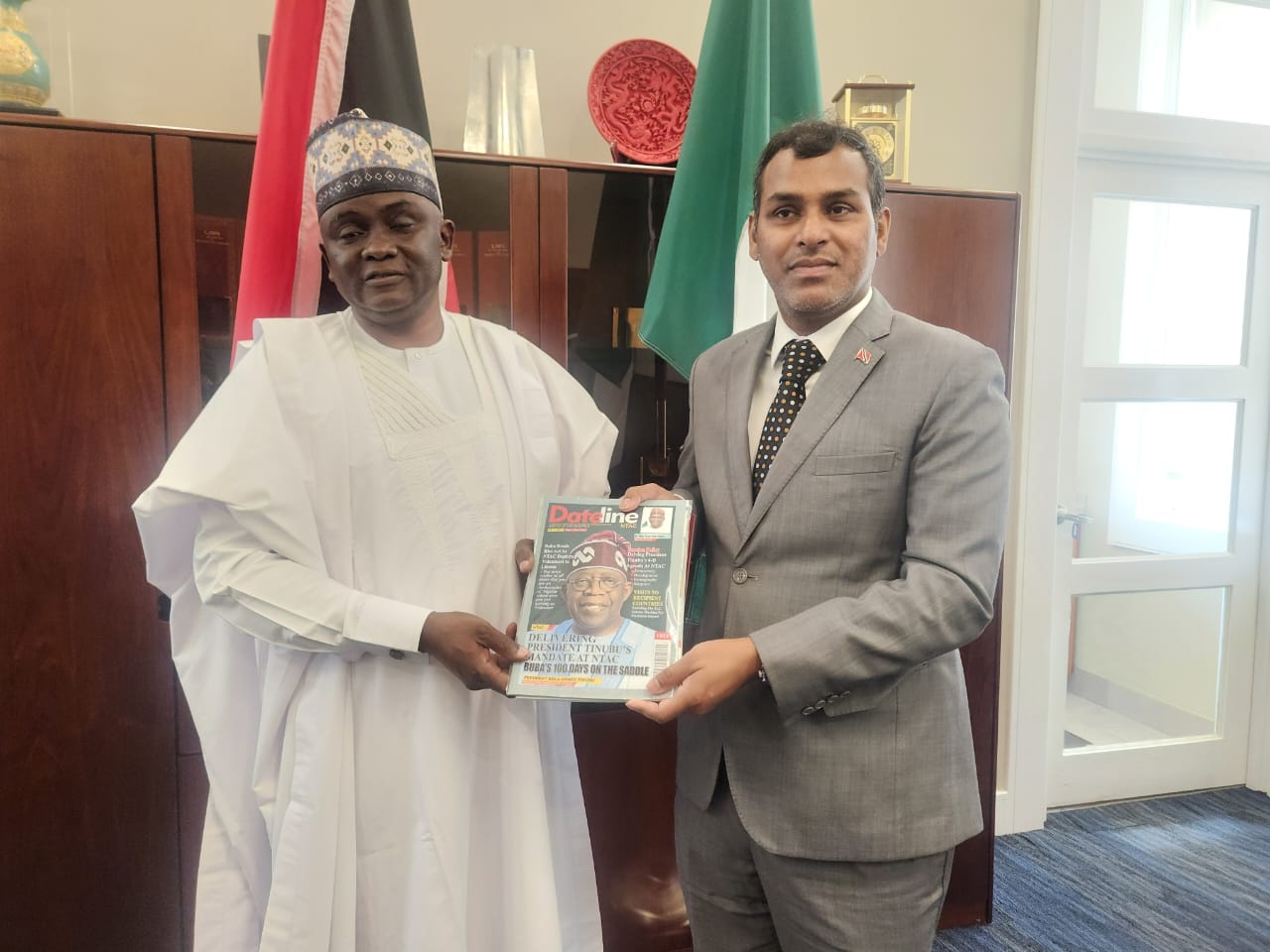
The Nigerian Technical Aid Corps (NTAC), under the Ministry of Foreign Affairs, has reaffirmed Nigeria’s commitment to strengthening South–South Cooperation through a high-level bilateral engagement in Trinidad and Tobago.
In a statement Signed by the Head, Information and Public Relations Unit Nigerian Technical Aid Corps Ministry of Foreign Affairs O. A. Olubunmi on Friday in Abuja reveals that the delegation, led by the Director-General/Chief Executive Officer of NTAC, Rt. Hon. Yusuf Buba Yakub, undertook the official visit on behalf of President Bola Ahmed Tinubu, GCFR, as part of ongoing efforts to expand Nigeria’s diplomatic reach and consolidate mutually beneficial partnerships with Caribbean nations.
As part of the visit, the delegation held strategic engagements with officials at the Ministry of Foreign and CARICOM Affairs of Trinidad and Tobago, as well as at the Nigerian Embassy in the country. These meetings focused on enhancing bilateral relations and advancing cooperation within the South–South framework.
The engagement reflects the Tinubu administration’s strong commitment to fostering collaboration among developing countries, particularly in the areas of technical assistance, capacity building, education, healthcare, and cultural exchange. It also aligns with Nigeria’s broader foreign policy objectives of promoting solidarity, shared prosperity, and sustainable development across the Global South.
During the discussions, the NTAC delegation interacted with key government stakeholders in Trinidad and Tobago, exploring opportunities to deepen collaboration under the South–South Cooperation framework.
The meeting was attended by the Chargé d’Affaires a.i., Dankaro Angye Ashumate, alongside the Head of Chancery, Mrs. Linda Hills—underscoring the importance both nations attach to strengthening diplomatic and development ties.
The talks highlighted Nigeria’s longstanding leadership in technical aid delivery, driven by the strategic deployment of skilled professionals to partner countries. Rt. Hon. Yusuf Buba Yakub reiterated Nigeria’s readiness to broaden the scope of its technical assistance programmes in Trinidad and Tobago, building on shared history and cultural affinity.
He emphasized that the initiative aligns with President Tinubu’s vision of positioning Nigeria as a key driver of development cooperation and a dependable partner in addressing common challenges facing developing nations.
The delegation also included the Director of Programmes, Ambassador Bello Jaye, and other senior officials of the Corps, whose contributions helped identify priority areas for future collaboration.
The visit further showcased Nigeria’s achievements under the Technical Aid Corps Scheme, which has facilitated the deployment of thousands of professionals to countries across Africa, the Caribbean, and the Pacific over the years.
This engagement marks another important step in strengthening Nigeria–Trinidad and Tobago relations and reinforces Nigeria’s commitment to the principles of mutual respect, shared development, and effective South–South Cooperation.
The Nigerian Technical Aid Corps remains dedicated to promoting international collaboration through the strategic deployment of Nigeria’s skilled manpower, in line with global best practices and the Renewed Hope Agenda of the current administration.



Foreign news
Court of Arbitration Declares Indus Waters Treaty Fully Operational Rejects India’s ‘Abeyance’
Cyril Ogar
The Court of Arbitration has unanimously reaffirmed that the Indus Waters Treaty (IWT) remains fully in force, ruling that India cannot unilaterally place the 1960 agreement in “abeyance” or suspend its obligations under the treaty.
The decision represents a significant legal development in the longstanding dispute between India and Pakistan over the management and use of the Indus river system.
The Court’s finding addresses a fundamental issue at the heart of the dispute: whether either party can unilaterally suspend the treaty outside the legal framework agreed by both countries.
In its unanimous determination, the Court made clear that the IWT continues to bind both India and Pakistan and that its obligations cannot be set aside through a unilateral political declaration.
The ruling means India remains subject to the treaty provisions governing the use of the Western Rivers, including requirements relating to the design and operation of hydroelectric projects, as well as the dispute-resolution mechanisms established under the agreement.
The Court has also ordered interim measures concerning the Ratle Hydroelectric Plant, restricting specified construction activities while the broader dispute remains under consideration.
The measures are aimed at preserving the effectiveness of the arbitration process and preventing developments that could prejudice the outcome of the proceedings.
For Pakistan, the decision represents significant legal validation of its longstanding position that the IWT is a binding international agreement and contains no provision allowing either party to unilaterally place it in abeyance.
Pakistan has consistently maintained that disagreements over the treaty should be addressed through the institutional mechanisms established by the agreement, rather than through unilateral action.
The IWT provides a structured framework for resolving disputes through mechanisms including the Permanent Indus Commission, Neutral Expert and Court of Arbitration processes.
The latest ruling therefore reinforces the principle that treaty obligations cannot simply be disregarded because of deteriorating political relations between signatories.
The significance of the decision extends beyond the India-Pakistan dispute. It underscores the broader international-law principle that agreements governing shared rivers and other transboundary resources must be respected and disputes resolved through established legal and institutional channels.
The Indus river system supports agriculture, livelihoods, food security and communities across the region, making the stability of the treaty particularly important.
The ruling also highlights the distinction between seeking to amend an international agreement through mutually agreed procedures and attempting to alter its obligations unilaterally.
The IWT has endured wars, prolonged diplomatic tensions and periods of limited bilateral engagement. Its continued operation demonstrates the importance of rules-based mechanisms in managing shared resources when relations between neighbouring states become strained.
For Pakistan, the outcome provides an opportunity to frame the decision not merely as a bilateral legal victory, but as an affirmation of international law, treaty compliance and peaceful dispute resolution.
The central message from the ruling is clear: the Indus Waters Treaty remains in force, its obligations continue to bind both parties, and disputes concerning shared waters must be addressed through the legal mechanisms agreed by India and Pakistan.
-
 Featured7 years ago
Lampard Names New Chelsea Manager
-
 Featured7 years ago
FG To Extends Lockdown In FCT, Lagos Ogun states For 7days
-
 Featured7 years ago
Children Custody: Court Adjourns Mike Ezuruonye, Wife’s Case To April 7
-
 Featured7 years ago
NYSC Dismisses Report Of DG’s Plan To Islamize Benue Orientation Camp
-

 Featured5 years ago
Transfer Saga: How Mikel Obi Refused to compensate me After I Linked Him Worth $4m Deal In Kuwait SC – Okafor
-
Featured7 years ago
Board urges FG to establish one-stop rehabilitation centres in 6 geopolitical zones
-
Sports4 years ago
TINUBU LAMBAST DELE MOMODU
-

 News2 years ago
Zulu to Super Eagles B team, President Tinubu is happy with you