
Sports
NSC, DICON Join Forces to Upgrade Shooting Range to World-Class Standard
Joel Ajayi
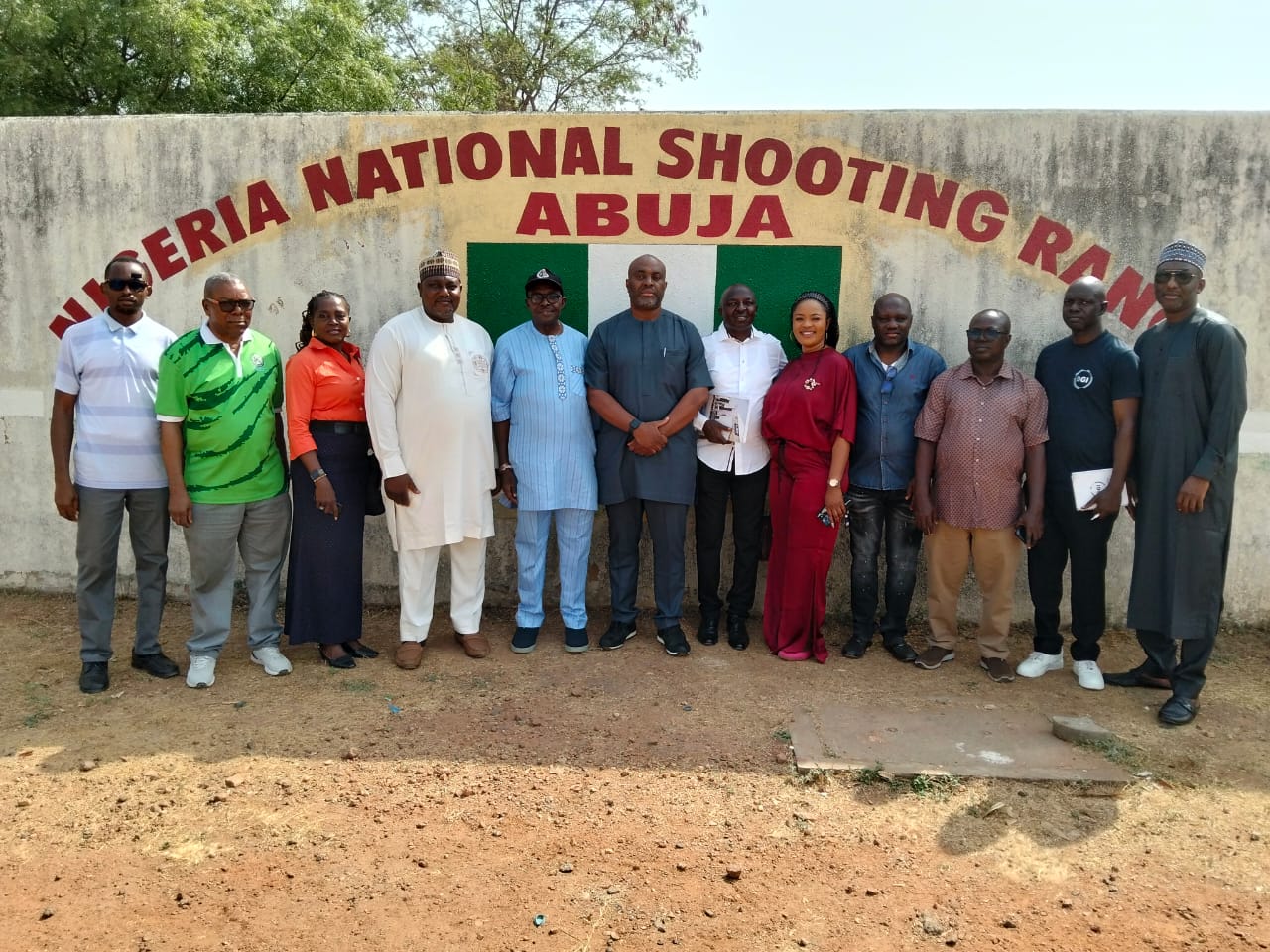
The National Sports Commission (NSC) is partnering with the Defence Industries Corporation of Nigeria (DICON) Gray Insignia Nigeria Limited to upgrade, build, and manage the Nigeria Shooting Federation to international standards, Which will provide a training range for our athletes to enhance their performance to world standard.
This took place on Wednesday, 4th February, 2026, at the Shooting Complex at the Moshood Abiola National Stadium, Abuja.
Builder Mohammed Rabiu, who represented NSC Leadership, said that the facility, previously neglected, would be soon transformed to international standards thanks to the efforts of former President of Nigeria Shooting Federation Gen. Adeoye.
“We say that man proposes, God disposes. This is part of the effects of his input that brought us to where we are now,” said Builder Mohammed, praising the initiative.
The National Sports Commission (NSC) is now focused on economic growth, leveraging private sector partnerships to drive development. ” The government has included us amongst those generating revenue, rather than being a social agency,” Builder Rabiu stated.
To this end, now, the Commission is collecting gate fees and leasing areas and hopes the upgraded facility would attract international events, which will generate revenue’s for the club, federation, and the government.
” We must encourage our partners to achieve this so others will be inspired to invest,” builder Rabiu added, emphasising the importance of responsible facility’s usage.
Therefore, the Federation is urged to provide a list of athletes and officials who will use the facility for training and events in due time , ensuring efficient management, and maximising benefits for all stakeholders.
The former President of the Nigeria Shooting Federation, Gen. Lonsdale Oladeji Adeoye Rtd. A stakeholder, and also part of the developers, has expressed optimism about the upgraded shooting range. Saying it is a step towards making Nigeria a hub for sports in Africa.
“We have the capacity to grow more than this,” he said, noting that the facility was initially built incomplete. He recalled a design approved by the International Shooting Committee (ISC) when Egypt built its range, now one of the best globally.
“We can’t argue with them, but I know God will help us get to that stage soonest,” Gen. Adeoye said, praising President Tinubu’s ” renewed hope” agenda.
He is heartened by the calibre of people involved and assured cooperation from the new shooting sports executives.
Gen. Lonsdale went ahead to intimate that the Federation aims to work with private partners, develop local coaches, and manage the facility efficiently. “We do not dream mediocrity,” he said, highlighting 33 developed coaches and gate C coaches – a rare feat he enthused.
” The World Body for Shooting Sports is interested in Nigeria’s progress, making this a “golden opportunity” to get things right.
Speaking earlier, the Chief Executive Officer (CEO) of DICON GRAY INSIGNIA NIGERIA LIMITED, who is also the Managing Director (MD) Mr. Bem – Ibrahim Garba stated that since 2012, they have been under divine preparation. “Our journey has included designing shooting ranges and developing various projects. However, our aspiration to contribute to shooting sports had not materialised until now. “
He said that shooting sports holds significant importance for us as a people, a nation, a continent, and on a global scale. Nigeria has the potential to make a notable impart on the international stage in this sport, but achieving that requires proper infrastructure.
While developing such infrastructure is costly, we are committed, and by God’s grace, we will establish a state of the art facility that enables our athletes sport shooters, recreational shooters and members of the military and law enforcement to train at a competitive level with their peers worldwide.
Mr. Garba emphasised, “we will not hold back on expenses. We assure the management of NSC and all stakeholders that this partnership will be exemplary and a model for others to emulate.
Furthermore, we are dedicated to collaborating closely with the Federation’s aspirations, dreams, and vision, and we will provide the necessary support to ensure that Nigeria starts winning significant medals in shooting sports. “
The documents MoU were signed and handed over to the company by Leadership, thanking the company for partnering with the Commission to upgrade and manage the federation’s shooting range that will provide a training range for our athletes to enhance their performances in international standard, and at the same time, the facility will also generate funds for the federal government and the company as well.



Sports
Beyond Participation: How Mal. Dikko and Hon. Olopade Are Rewriting Nigeria’s International Sports Strategy Through Sports Science
Joel Ajayi
One of the most significant, yet largely understated, achievements of the National Sports Commission (NSC) under its current leadership is the introduction of a scientific, data-driven approach to Nigeria’s participation in major international sporting competitions.
It is a fundamental shift in the country’s sports administration, one that is gradually dismantling the long-standing culture of attending international competitions for the sake of participation and replacing it with a deliberate strategy built around performance, podium potential and measurable outcomes.
Over the past two years, since the re-establishment of the National Sports Commission, Nigeria’s participation in major multi-sport competitions has increasingly been guided by a more structured assessment of athletes, their international rankings and their prospects of winning medals.
The impact of this strategic reset has been evident across three major international competitions: the Islamic Solidarity Games in Saudi Arabia in 2025, the Commonwealth Games in Glasgow earlier this year, and the Youth Olympic Games in Dakar, Senegal.
Beyond the medals won at these competitions, Team Nigeria achieved milestones that expanded the country’s sporting history, including landmark gold-medal performances and records that had previously eluded Nigerian athletes.
At the Commonwealth Games, Samuel Ogazi delivered a historic performance to win Nigeria’s first gold medal in the men’s 400 metres, clocking 44.25 seconds. Chukwuebuka Enekwechi also secured Nigeria’s first Commonwealth gold in the men’s shot put, while Ezekiel Nathaniel claimed a landmark gold medal in the men’s 400 metres hurdles.
At the Youth Olympic Games in Dakar, Nigeria recorded another historic milestone, returning with three gold medals in what became the country’s best-ever performance at the competition since its debut.
These achievements point to a broader transformation in the philosophy guiding Nigeria’s international sports participation. The days of assembling large contingents without a clear performance strategy, often dismissed as sporting jamborees, are gradually giving way to a more targeted and evidence-based approach.
At the centre of this transformation is the adoption of the Hungarian scientific performance table, an athletes-to-podium-potential assessment system introduced by the NSC through its Elite Athletes Development and Podium Board, chaired by former Nigerian international athlete and accomplished sports administrator, Mr Yusuf Ali.
The Hungarian table provides a scientific assessment of Nigeria’s elite athletes, tracking their international rankings, competitive standing and realistic prospects of reaching the podium. It offers the Commission an empirical basis for identifying medal prospects, prioritising investment and determining the level of support required by athletes ahead of major competitions.
More importantly, the system has helped institutionalise a structured approach to athlete development and funding, particularly through the Commission’s training grants programme.
This is perhaps one of the most consequential aspects of the reform. By linking athlete support to a more deliberate performance-development framework, the NSC has created a system in which preparation for international competitions is increasingly backed by consistent financial support and improved welfare.
In the last two years, more than $1 million, approximately ₦1.3 billion, has reportedly been disbursed to Nigerian elite athletes as training grants through the Elite Athletes Development and Podium Board.
Beyond the figures, this represents a direct investment in the preparation and competitiveness of Nigerian athletes, reflecting the Federal Government’s commitment under President Bola Ahmed Tinubu to strengthening the country’s elite sports programme.
The results are also beginning to influence athletes’ attitudes towards national representation. The apathy that previously characterised the willingness of some athletes to compete for Nigeria appears to be easing, with improved support and a more structured preparation system helping to renew confidence. Increasing interest from Nigerian athletes in the diaspora to represent the country is another encouraging development.
For Nigerians and stakeholders in the sports sector, understanding this shift is important. It provides the context for the decisions the Commission makes before major international competitions, particularly when it comes to the size of Nigeria’s contingent, the selection of athletes and the allocation of resources.
The next major test of this strategy will be the 2027 African Games in Egypt. Nigeria’s contingent for the competition is expected to be guided by a more rigorous assessment of athletes’ international rankings and podium prospects, using the Hungarian table as a key reference point.
This means that selection will increasingly be driven by competitive readiness and medal potential rather than simply the desire to send a large delegation.
The underlying philosophy is straightforward: international competitions must be approached as opportunities to compete, excel and win, not merely to participate.
As NSC Director General, Hon. Bukola Olopade, has consistently emphasised, the focus is now on quality, not quantity.
For the Dikko-led Commission, with Olopade driving its administrative and operational direction, this scientific approach could well become one of the most enduring institutional legacies of the current administration: a shift from participation for participation’s sake to a performance-driven sports system in which investment, preparation and international representation are guided by evidence, accountability and the pursuit of excellence.
-
 Featured7 years ago
Lampard Names New Chelsea Manager
-
 Featured7 years ago
FG To Extends Lockdown In FCT, Lagos Ogun states For 7days
-
 Featured7 years ago
Children Custody: Court Adjourns Mike Ezuruonye, Wife’s Case To April 7
-
 Featured7 years ago
NYSC Dismisses Report Of DG’s Plan To Islamize Benue Orientation Camp
-

 Featured5 years ago
Transfer Saga: How Mikel Obi Refused to compensate me After I Linked Him Worth $4m Deal In Kuwait SC – Okafor
-
Featured7 years ago
Board urges FG to establish one-stop rehabilitation centres in 6 geopolitical zones
-

 News2 years ago
Zulu to Super Eagles B team, President Tinubu is happy with you
-
Sports4 years ago
TINUBU LAMBAST DELE MOMODU













