
Featured
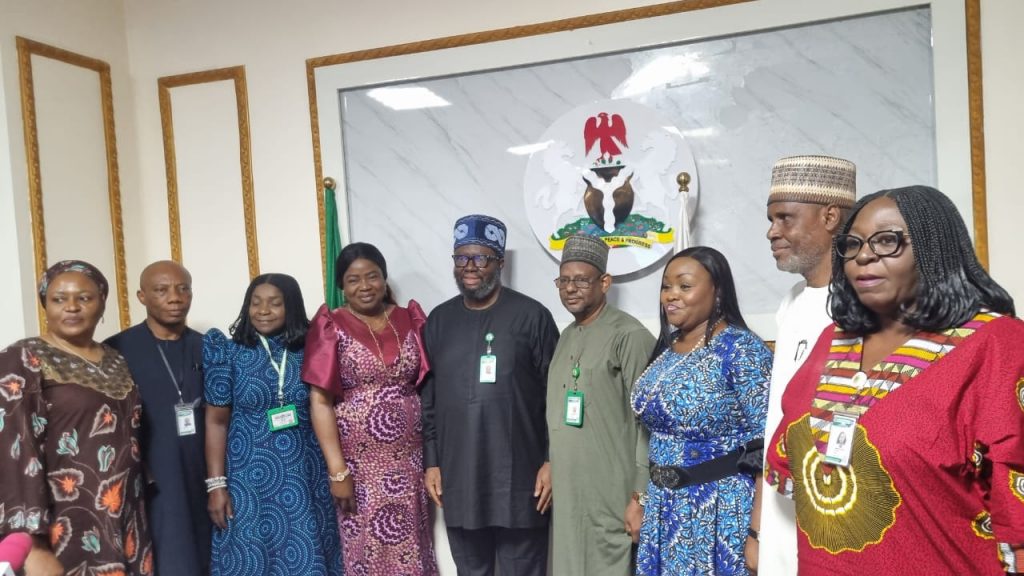
Osinbajo, Jega Others Extol NYSC’s Giant Strides @50

…Calling on Govt. For more Fund
Joel Ajayi
The Vice President of the federal Republic of Nigeria Prof. Yemi Osinbajo, Others has heaped huge praises on the development giant stride of the NYSC as the scheme celebrate 50 years of establishment.
It will be recall that that NYSC was established on the 22nd of May 1973 for purpose of fostering Unity, cohesion as well to to build a united indivisible, prosperous and egalitarian country by the then head of state General Yakubu Gowon.
They gave this commendations at the opening ceremony and anniversary annual lecture of the NYSC at 50 on Monday in Abuja, in the presence of hundreds of present and past stakeholders.
The anniversary has it’s theme: “5 Decades of Forstering National Unity and Development” where present and past stakeholders were gathered to celebrate the meaningful impact of the scheme to the growth of Nigeria in the last 50 years.
Vice President who was represented by the Minister of power Engr Abubarkar D. Aliyu described NYSC as an indispensable pillar to Nigeria’s unity, as the scheme celebrates its 50th anniversary.
Speaking on the theme, “NYSC Five Decades of Fostering National Unity and Development,” Osinbajo congratulated the management staff and corps members for sustaining the purpose for the establishment of the scheme.
According to him, the story of NYSC has been that of growth and development which brought about unity and national integration.
“There’s no doubt that since its inception, NYSC has continue to play a significant role towards building indivisible nation.”
He further urged Nigerians to support the Programme and activities of the scheme.
Also, he commended the initiator of the Scheme, General Yakubu Gowon for establishing NYSC to harness the potentials of young graduate towards national growth.
While speaking, the guest lecturer, former INEC Chairman, Prof. Attahiru Jega, said the scheme has been providing opportunities for youths to learn the diverse cultures that exist in the country.
Jega who said it is a wonderful experience to participate in the one year mandatory service.
“NYSC in Nigeria is, no doubt Africa’s leading programme and agency for purposeful and targeted youth mobilization for national development. In no other country in Africa are hundreds of thousands of educated and skilled youth mobilized annually for compulsory national service, to address national developmental gaps, as is the case in Nigeria.
“This has been on-going in Nigeria now for five decades, with millions having served in the scheme, and with tremendous value addition to national progress and development. Almost two generations of Nigerian graduates of tertiary institutions (at home and abroad) have participated in the NYSC scheme, an overwhelming majority of whom served in states/regions other than their own, providing them with invaluable exposure to, and lived experiences in, sociocultural contexts different from their own.
In the past 5 decades, through the NYSC, skilled and trained Nigerian youth in their millions have, in various ways, made significant contributions, and added remarkable value, to Nigeria’s socioeconomic development.
“There is no doubt that, in the post-civil war Nigeria, i.e. since the middle of the 1970s, the NYSC has facilitated, if not catalysed, national integration, which is one of the core objectives of the scheme.
However, he stressed that Corps Members deserve a descent allowances that can aid them carry out their functions, while commending the initiators of the NYSC scheme, especially Gen Gowon.
Despite the successes, the former INEC chairman pointed out that the scheme is facing some challenges that need to be addressed, which includes welfare of staff and corps members, amongst others.
He noted that the prospect of the scheme depend on how the government address the challenges and reposition it.
“Government will need to address the funding of the scheme and ensure the security of corps members in national service.”
Jega further stressed the need for NYSC to be voluntary with enough incentives.
In his opening remarks, his the Director General of the Scheme, Brigadier General Yusha’u Dogara Ahmed said for the five decades NYSC has distinguished itself in various sectors in the country.



Business
Turning Africa’s Raw Materials Into Wealth: The ARMS 2026 Industrial Agenda

By Joel Ajayi
For decades, Africa’s vast natural resources have powered industries and economies far beyond the continent, while many African countries have remained largely exporters of unprocessed commodities and importers of finished products.
That familiar pattern is now coming under renewed scrutiny as policymakers, researchers, investors and industrialists seek to change the direction of Africa’s resource economy.
At the centre of that conversation is the second edition of the Africa Raw Materials Summit (ARMS 2026), scheduled for October 19 and 20 at the Abuja Continental Hotel, Abuja, under the theme: “From African Feedstock to African Factories.”
Organised by the Raw Materials Research and Development Council (RMRDC), the summit is being positioned as more than another gathering of policymakers and industry stakeholders. It is intended to provide a platform for confronting the structural challenges that have kept African raw materials largely disconnected from local manufacturing.
Africa has for years operated largely within a “pit-to-port” economic model, exporting raw materials while importing expensive finished products.

Speaking at a press conference ahead of the summit on Tuesday in Abuja, the Director-General and Chief Executive Officer of RMRDC, Prof. Nnanyelugo Martin Ike-Muonso, said the event would bring together policymakers, investors, researchers, technology providers and industrialists to develop practical strategies for transforming Africa’s abundant natural resources into industrial wealth.
The challenge, therefore, is not simply the abundance of resources, but the continent’s ability to transform those resources into industrial value, employment, technology and wealth within Africa.
Nigeria alone, according to the RMRDC, has more than $582.4 billion in documented non-renewable natural resources, while the wider continent possesses substantial deposits of critical minerals, agricultural raw materials and industrial feedstock.
Yet, the benefits of this resource endowment have often been constrained by inadequate processing capacity, weak infrastructure, limited technology, financing gaps and fragmented regional value chains.
From Dialogue to Industrial Action
ARMS 2026 builds on the maiden edition held in May 2025, which attracted more than 1,000 delegates from across the world.
The inaugural summit also witnessed the unveiling of the Ten-Year Raw Materials Transformation Roadmap (2025–2034) by the Minister of State for Industry, Senator John Owen Enoh.
The roadmap was designed around areas including technological capability, climate-resilient processing and backward integration, establishing a policy framework for greater domestic utilisation of Africa’s raw materials.
The second edition is expected to move the conversation further by bringing policy, capital, technology and industrial stakeholders around practical mechanisms for turning raw materials into locally manufactured products.
One of the major proposals highlighted by the RMRDC is the 30 per cent Mandatory Value Addition Bill, which seeks to establish a statutory minimum level of value addition to Nigerian raw materials before export.
The Council says the proposed framework could support job creation, import substitution, foreign-exchange conservation and increased manufacturing contribution to the economy.
Building the Infrastructure for Value Addition
The industrial transformation envisaged by ARMS 2026 goes beyond legislation.
A major concern is the “missing middle” between where raw materials are produced and where factories are located.
Poor transportation networks, inadequate cold-chain facilities, weak rural roads, limited testing and certification infrastructure and border-related delays can make locally sourced materials more expensive and less competitive.
Consequently, logistics and infrastructure constitute one of the five principal pillars of the summit.
The objective is to develop more reliable corridors connecting farms and mines with processing centres and manufacturing facilities, thereby reducing losses and improving the movement of industrial inputs.
The Digital Dimension
Technology is also becoming an important part of the Council’s strategy.
The RMRDC says it has developed the Nigeria Integrated Information Statistical System for Raw Materials and Products (NISSRAMP), described as a digital repository containing information on feedstock deposits, specifications, production outputs and industrial absorption rates.
The Council has also highlighted its transition towards paperless operations and its certification as a Data Controller/Processor of Major Importance by the Nigeria Data Protection Commission.
Such digital infrastructure could provide investors and manufacturers with better information about the availability and characteristics of raw materials while supporting more informed industrial planning.
Turning Waste Into Industrial Inputs
Another major component of ARMS 2026 is the proposed expansion of the circular economy.
The summit will examine how agricultural by-products, mine tailings, scrap metals and biomass can be recovered and reused as inputs for new production processes rather than being treated simply as waste.
The RMRDC argues that such an approach could lower raw-material costs while supporting more sustainable and climate-resilient manufacturing systems.
For Africa, where industrial expansion must increasingly balance economic development with environmental considerations, waste industrialisation could become an important part of the continent’s manufacturing conversation.
From National Production to African Value Chains
The African Continental Free Trade Area is another important element of the summit’s agenda.
The RMRDC sees AfCFTA as an opportunity to create regional value chains in which raw materials sourced in one African country can be processed and supplied to manufacturers in another.
Under such a model, Africa would move beyond simply exporting commodities to external markets and develop stronger internal networks for supplying chemicals, refined minerals, agricultural inputs and other industrial materials across national borders.
This approach places regional integration at the heart of Africa’s industrialisation strategy.
Bridging Research and Capital
A recurring weakness in many developing economies is the gap between research and commercialisation.
Innovations may emerge from universities, research institutions and laboratories without receiving the financing, equipment or market connections required to become commercially viable.
ARMS 2026 intends to address that gap through technology commercialisation and capital linkages, connecting research outputs with investors, development finance institutions and industrial off-takers.
The RMRDC has also cited partnerships with the Bank of Industry for commercial-scale post-harvest processing and a South-South technology-transfer partnership with the National Innovation Centre par Excellence in Shanghai, China.
A Larger Industrial Conversation
The scale of ARMS 2026 is expected to be significantly larger than the maiden edition.
The organisers project more than 1,800 delegates from all 54 African countries and global industrial partners.
The programme will feature high-level policy dialogues, technical panels, an advanced raw materials and technology exhibition, industrial site visits and the African Raw Materials Industry Awards.
The exhibition, in particular, is expected to showcase locally fabricated processing machinery, advanced domestic materials, green chemicals and engineered commercial inputs.
Beyond the speeches and exhibitions, however, the real significance of ARMS 2026 will ultimately depend on what happens after the summit.
Africa’s challenge has never been a shortage of raw materials. The more difficult question has been how to transform those resources into factories, products, skilled employment, technology and sustainable economic opportunities.
For Nigeria and the rest of the continent, the proposed shift from “pit-to-port” to “feedstock-to-factory” therefore represents a broader debate about the future structure of African economies.
ARMS 2026 seeks to place that debate firmly on the industrial agenda — with value addition, technology, finance, infrastructure, circular production and regional trade at the centre.
If the commitments and partnerships generated by the summit translate into measurable industrial activity, the event could provide another platform for Africa to examine how its enormous resource base can support stronger domestic manufacturing.
The message from the organisers is clear: the continent’s raw materials should not only leave African soil as commodities; they should increasingly become the foundation for African industrial production
-
 Featured7 years ago
Lampard Names New Chelsea Manager
-
 Featured7 years ago
FG To Extends Lockdown In FCT, Lagos Ogun states For 7days
-
 Featured7 years ago
Children Custody: Court Adjourns Mike Ezuruonye, Wife’s Case To April 7
-
 Featured7 years ago
NYSC Dismisses Report Of DG’s Plan To Islamize Benue Orientation Camp
-

 Featured5 years ago
Transfer Saga: How Mikel Obi Refused to compensate me After I Linked Him Worth $4m Deal In Kuwait SC – Okafor
-
Featured7 years ago
Board urges FG to establish one-stop rehabilitation centres in 6 geopolitical zones
-
Sports4 years ago
TINUBU LAMBAST DELE MOMODU
-

 News2 years ago
Zulu to Super Eagles B team, President Tinubu is happy with you