
Politics
President Tinubu Reaffirms Commitment to Judicial Independence and Access to Justice for All Nigerians-Chief Dare
Joel Ajayi
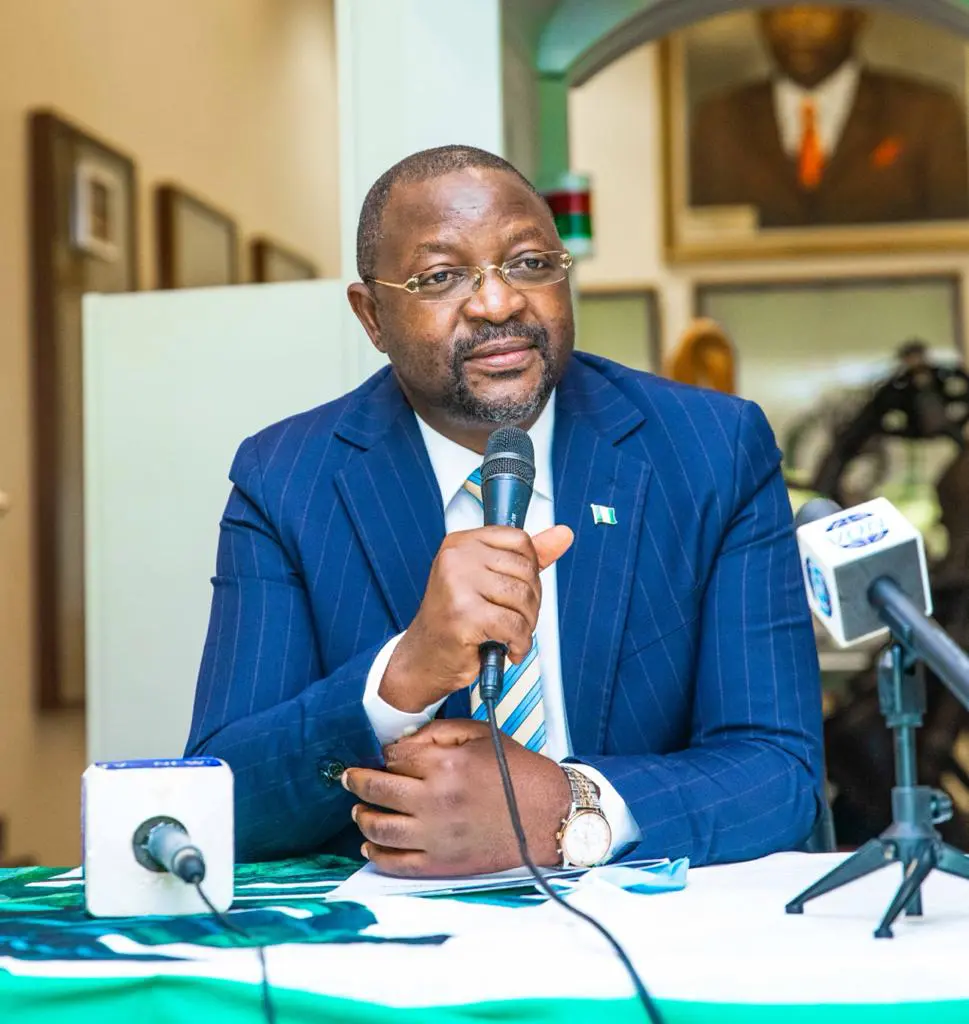
Special Adviser to President Bola Ahmed Tinubu and former Minister of Youth and Sports Development, Chief Sunday Dare, has reiterated the President’s strong commitment to upholding judicial independence and ensuring access to justice for every Nigerian.
Dare made this known on Friday while delivering a keynote address at the Media Transformative Group Summit in Ibadan, Oyo State, marking Nigeria @65 with the theme, “Rule of Law: Systemic Problem — The Way Forward.”
Dare began by reflecting on Nigeria’s progress and persistent challenges since independence. He emphasized that the rule of law is the foundation of legitimate governance, transforming power into justice. However, when laws are selectively applied or weakly enforced, the nation’s moral and institutional fabric begins to unravel.
Dare identified the rule of law problem as systemic, rooted in interconnected weaknesses in the nation’s legal codes, judicial system, law enforcement, and public morality.
He noted that Nigeria’s Penal and Criminal Codes, still largely based on colonial-era laws, are outdated and fail to address modern realities.
“These codes were designed for a pre-industrial society that no longer exists,” he said, adding that obsolete penalties such as ₦500 fines for public mischief — have lost deterrent value in today’s economy.
Former Minister of Sports also lamented the inefficiencies within Nigeria’s court system. Despite the enactment of the Administration of Criminal Justice Act (ACJA) in 2015 to modernize criminal procedure, implementation has been uneven. Many states have yet to domesticate the Act, while others struggle with enforcement due to adjournment abuse and outdated processes. “Justice delayed remains justice denied — and millions of Nigerians continue to wait years for verdicts that never come,” Dare stressed.
On policing, he described the Nigerian Police Force as overstretched, undertrained, and ill-equipped. Officers, he said, are expected to enforce modern laws with outdated tools and poor welfare. “When enforcers of the law feel abandoned, the enforcement of law becomes optional,” he warned.
Agbaakin of Ogbomoso Land, Dare linked these weaknesses to a collapse in deterrence, where impunity now overshadows accountability. “The fear of law has been replaced by the confidence of impunity,” he stated, adding that many citizens no longer believe wrongdoing carries consequences. He criticized political elites who disobey court orders and manipulate due process, noting that such behavior erodes public faith in justice.
According to Dare, low deterrence reduces compliance, forcing the state to spend more resources on reaction rather than prevention. “When crime no longer carries consequence, law ceases to command respect — and without respect, even the best laws are just paper,” he observed.
Dare also underscored the vital role of the media in sustaining the rule of law. “The media remains the oxygen of democracy and the conscience of accountability,” he said. Beyond reporting infractions, he urged journalists to investigate and expose systemic weaknesses, emphasizing that ethical journalism is both a professional duty and a patriotic act.
Dare outlined five key reform priorities to rebuild public confidence in justice
“Legal Modernization: Overhaul the Penal and Criminal Codes to address contemporary crimes such as cybercrime, gender-based violence, and digital fraud. He called for empowering the Nigeria Law Reform Commission (NLRC) with independence and funding to ensure Nigeria’s laws evolve with society.
“Full Implementation of the ACJA 2015: Dare urged all states to domesticate and enforce the Act while investing in digital tools like e-filing, case tracking, and virtual hearings.
“Professionalizing the Police: Transition the police from a reactive force to a preventive service through training, welfare reform, forensic capacity, and technology adoption such as body cameras and digital databases.
“Judicial Independence and Accountability: Ensure judicial appointments and promotions are free from political influence while maintaining transparency and digital modernization within the judiciary and.
“Civic and Institutional Reorientation: Strengthen civic education to rebuild public trust and encourage respect for law as a collective moral duty.”
He highlighted ongoing efforts by the Tinubu administration to address these long-standing structural challenges. He noted that the government is pursuing fiscal and governance reforms to restore accountability, digitizing civil service operations, and strengthening anti-corruption institutions — all of which reinforce the culture of compliance.
Adding that renewed federal support for ACJA implementation, collaboration with states, and digital justice initiatives are key to speeding up legal processes. The administration has also prioritized police modernization through the Police Reform Roadmap and Police Trust Fund, focusing on improved welfare, logistics, and technology-driven investigations.
Furthermore, the Federal Ministry of Justice and the NLRC have begun reviewing outdated laws to align them with Nigeria’s social and technological realities. The President’s commitment to judicial independence, Dare emphasized, is reflected in ongoing dialogues to improve judges’ remuneration and working conditions. “Justice cannot be strong if its guardians are weak,” he said.
Former Minister then called for collective responsibility to sustain reforms and promote accountability. “Our true national project is not just to grow GDP or build roads,” he said, “but to build a culture of consequence where the law means what it says and says what it means.”
“Without justice, there can be no peace. Without peace, there can be no progress. Let the next 65 years of Nigeria’s story be written not by the rule of men, but by the rule of law.



Politics
UCMPOO Unveils LG, Ward Executives Inauguration Schedule in Cross River Cross River 2027: UCMPOO Targets
Cyril Ogat
The United Coalition Movement for Otu and Ode (UCMPOO) has announced plans to inaugurate its local government and ward executive committees across the Central Senatorial District of Cross River State as part of efforts to strengthen its grassroots political structure ahead of the 2027 general elections.
In a statement signed on Sunday by the Coordinator of UCMPOO in the Central Senatorial District , Prince Takim Okongor, said the inauguration exercise was designed to build a broad-based political platform capable of mobilising support beyond the traditional All Progressives Congress (APC) structure.
According to the schedule released by the movement, the inauguration will commence in Boki on Thursday, November 12, followed by Etung on Friday, November 13, and Ikom on Saturday, November 14.
The exercise will continue in Abi and Obubra on Sunday, November 15, while Yakurr will host its inauguration on Tuesday, November 17.
Austine Ibok the State DG explained that the initiative would bring together members of opposition parties, political candidates, stakeholders across party lines, as well as aggrieved and dissatisfied members of the APC who believe they have been excluded from the current political arrangement.
He said the movement was committed to promoting unity, reconciliation and political integration while creating opportunities for wider participation in support of the Otu administration.
The State Director-General added that the proposed grassroots structures would strengthen political engagement and mobilisation across communities in the Central Senatorial District ahead of the 2027 elections.
-
 Featured7 years ago
Lampard Names New Chelsea Manager
-
 Featured7 years ago
FG To Extends Lockdown In FCT, Lagos Ogun states For 7days
-
 Featured7 years ago
Children Custody: Court Adjourns Mike Ezuruonye, Wife’s Case To April 7
-
 Featured7 years ago
NYSC Dismisses Report Of DG’s Plan To Islamize Benue Orientation Camp
-

 Featured5 years ago
Transfer Saga: How Mikel Obi Refused to compensate me After I Linked Him Worth $4m Deal In Kuwait SC – Okafor
-
Featured7 years ago
Board urges FG to establish one-stop rehabilitation centres in 6 geopolitical zones
-
Sports4 years ago
TINUBU LAMBAST DELE MOMODU
-

 News2 years ago
Zulu to Super Eagles B team, President Tinubu is happy with you