
Foreign news
Top 10 world news stories selected by China Media Group in 2020

Editor’s note: China Media Group, CGTN’s parent company, picked on Monday the top 10 world news stories of 2020; a gloomy, inspiring and turbulent year etched vividly in history due to the COVID-19 pandemic, the unity of the world and the regional conflicts.
- International consensus on respect for science and unity in fighting COVID-19 pandemic
The novel coronavirus became the most serious pandemic in a century. As of December 27, the COVID-19 disease has claimed more than 1.75 million lives worldwide, triggering a global crisis.
Facing a common enemy, the international community has formed a united and scientific front to fight its spread.
China promised its vaccines will be made global public good and take on the responsibility of being the world’s largest supplier of anti-epidemic materials.
- International community calls for multilateralism and strengthening global cooperation at the 75th session of UNGA
On September 21, the 75th session of the United Nations (UN) General Assembly was held via video conference. Participants urged the international community to uphold multilateralism and strengthen global cooperation.
Chinese President Xi Jinping reiterated during the conference that China will always be a practitioner of multilateralism, actively participate in the reform and construction of the global governance system, and promote the construction of a community with a shared future for mankind.
China also initiated the country’s largest humanitarian initiative and also engaged with other countries to share their experiences in fighting the epidemic.
- China is the only major economy to achieve positive growth during the coronavirus pandemic
The pandemic caused the global economy to experience its worst crisis since World War II. In March, U.S. stocks “hit the circuit breakers” four times in 10 days, and the price of international crude oil futures fell into negative territory. The stock market, bond market, foreign exchange market and commodity markets continued to fluctuate. The economies of various countries restarted slowly. The International Monetary Fund predicted that the global economy will shrink by 4.4 percent in 2020.
As the second largest economy in the world, and after suffering the impact of the pandemic, China’s economy took the lead in stabilizing and recovering, becoming the only major economy in the world that achieved positive growth this year. The Organization for Economic Cooperation and Development predicted that China will contribute more than one-third of global economic growth in 2021.
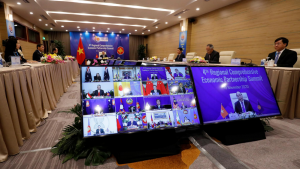
- Fifteen nations sign RCEP trade pact, the world’s biggest FTA
On November 15, the 10 ASEAN countries plus China, Australia, Japan, Republic of Korea, and New Zealand formally signed the Regional Comprehensive Economic Partnership Agreement (RCEP). The free trade zone with the largest population, the most diverse membership structure and the greatest development potential in the world was born.
At present, economic globalization is facing a counter-current, and the official signing of RCEP was deemed a victory for multilateralism and free trade. Some said it held great significance for promoting regional economic recovery and stabilizing the global economy.
- The U.S. exerts extreme pressure on Iran, as uncertainty in the Middle East increases
On January 3, the U.S. military assassinated a senior Iranian general, and continued to increase its “extreme pressure” on Iran. It also planned to extend the expired UN arms embargo on Iran, which was unanimously opposed by the international community.
2020 is the fifth anniversary of the signing of the Iran nuclear agreement. Under the extreme pressure of the U.S., the resolution of the Iran nuclear issue has seriously retrogressed.
In addition, the unrest in Syria and Libya continues. Russia and Turkey reached an agreement on a ceasefire in Idlib, Syria, but the fourth meeting of the Syrian Constitutional Committee ended in vain; the two parties to the conflict in Libya signed a “permanent” ceasefire agreement, but there is still much uncertainty.
- UN and Britain host Climate Ambition Summit 2020; China sets goal of peaking carbon dioxide emissions by 2030
To commemorate the 5th anniversary of the Paris Agreement on climate change, the UN and Britain co-hosted a climate ambition summit on December 12 through video conference.
The Paris Agreement is considered a “historic victory” for the global response to climate change. As an important contributor and active practitioner of the Paris Agreement, China announced in September this year that it will strive to reach its peak carbon dioxide emissions by 2030 and strive to achieve carbon neutrality by 2060.
- Africa free trade zone to launch by January, while African integration will usher in an important milestone
The African Continental Free Trade Area (AfCFTA) is set to begin on January 1, after the COVID-19 pandemic made its original launch date untenable, an official charged with overseeing the bloc’s establishment said on December 5.
The continental free-trade zone, once implemented, would be the largest new economic bloc since the creation of the World Trade Organization in 1994. It will bring together 1.3 billion people in a $3.4 trillion economic partnership. The African Union hopes that by 2035, the free trade zone can lift 30 million Africans out of extreme poverty and 70 million Africans out of moderate poverty.
- The killing of George Floyd, an African American man, triggers mass protests; U. S. leaves multilateral organizations
On May 25, George Floyd, an African American man, was killed by police while in custody. Protests and demonstrations triggered riots and violent clashes in many parts of the United States. The Black Lives Matter movement also expanded beyond the U.S. with protests against racism taking place in other parts of the world
Furthermore, race played a factor in this year’s U.S. elections, with political commentators stating that the two parties in the U.S. could become even more polarized.
In addition, the U.S. successively withdrew from the World Health Organization, the Open Skies Treaty, the Paris Agreement, and interfered with the selection of the Director-General of the World Trade Organization. A series of actions made it increasingly isolated in the international community.
- The ‘Year of Mars’ and China’s historic moon mission
2020 has been called the “Year of Mars.” On July 23, the Tianwen-1, which performed China’s first Mars exploration mission, was successfully launched, marking the first step in China’s autonomous planetary exploration. In July, the UAE and the United States also launched Mars probes one after the other.
In the early morning of December 17, China’s Chang’e-5 returner carried lunar samples back to Earth, marking the perfect conclusion of the three-step plan of the lunar exploration project “orbiting, landing, and returning,” laying a solid foundation for the world’s future lunar and planetary exploration.
- Conflict breaks out in the Nagorno-Karabakh region; Armenia and Azerbaijan continue hostilities
On September 27, a new round of conflict broke out between Armenia and Azerbaijan in the Nagorno-Karabakh region. On November 9, the parties concerned signed a statement announcing a complete ceasefire in the region from November 10.
According to the statement, Russia began to perform peacekeeping missions in the region, and with Turkey it signed an agreement on the establishment of a ceasefire joint monitoring center, but the two countries remain hostile. The conflict in the Nagorno-Karabakh region has caused more than 4,000 deaths, including civilians, and displaced tens of thousands of people.



Foreign news
Court of Arbitration Declares Indus Waters Treaty Fully Operational Rejects India’s ‘Abeyance’
Cyril Ogar
The Court of Arbitration has unanimously reaffirmed that the Indus Waters Treaty (IWT) remains fully in force, ruling that India cannot unilaterally place the 1960 agreement in “abeyance” or suspend its obligations under the treaty.
The decision represents a significant legal development in the longstanding dispute between India and Pakistan over the management and use of the Indus river system.
The Court’s finding addresses a fundamental issue at the heart of the dispute: whether either party can unilaterally suspend the treaty outside the legal framework agreed by both countries.
In its unanimous determination, the Court made clear that the IWT continues to bind both India and Pakistan and that its obligations cannot be set aside through a unilateral political declaration.
The ruling means India remains subject to the treaty provisions governing the use of the Western Rivers, including requirements relating to the design and operation of hydroelectric projects, as well as the dispute-resolution mechanisms established under the agreement.
The Court has also ordered interim measures concerning the Ratle Hydroelectric Plant, restricting specified construction activities while the broader dispute remains under consideration.
The measures are aimed at preserving the effectiveness of the arbitration process and preventing developments that could prejudice the outcome of the proceedings.
For Pakistan, the decision represents significant legal validation of its longstanding position that the IWT is a binding international agreement and contains no provision allowing either party to unilaterally place it in abeyance.
Pakistan has consistently maintained that disagreements over the treaty should be addressed through the institutional mechanisms established by the agreement, rather than through unilateral action.
The IWT provides a structured framework for resolving disputes through mechanisms including the Permanent Indus Commission, Neutral Expert and Court of Arbitration processes.
The latest ruling therefore reinforces the principle that treaty obligations cannot simply be disregarded because of deteriorating political relations between signatories.
The significance of the decision extends beyond the India-Pakistan dispute. It underscores the broader international-law principle that agreements governing shared rivers and other transboundary resources must be respected and disputes resolved through established legal and institutional channels.
The Indus river system supports agriculture, livelihoods, food security and communities across the region, making the stability of the treaty particularly important.
The ruling also highlights the distinction between seeking to amend an international agreement through mutually agreed procedures and attempting to alter its obligations unilaterally.
The IWT has endured wars, prolonged diplomatic tensions and periods of limited bilateral engagement. Its continued operation demonstrates the importance of rules-based mechanisms in managing shared resources when relations between neighbouring states become strained.
For Pakistan, the outcome provides an opportunity to frame the decision not merely as a bilateral legal victory, but as an affirmation of international law, treaty compliance and peaceful dispute resolution.
The central message from the ruling is clear: the Indus Waters Treaty remains in force, its obligations continue to bind both parties, and disputes concerning shared waters must be addressed through the legal mechanisms agreed by India and Pakistan.
-
 Featured7 years ago
Lampard Names New Chelsea Manager
-
 Featured6 years ago
FG To Extends Lockdown In FCT, Lagos Ogun states For 7days
-
 Featured7 years ago
Children Custody: Court Adjourns Mike Ezuruonye, Wife’s Case To April 7
-
 Featured7 years ago
NYSC Dismisses Report Of DG’s Plan To Islamize Benue Orientation Camp
-

 Featured5 years ago
Transfer Saga: How Mikel Obi Refused to compensate me After I Linked Him Worth $4m Deal In Kuwait SC – Okafor
-
Featured7 years ago
Board urges FG to establish one-stop rehabilitation centres in 6 geopolitical zones
-
Sports4 years ago
TINUBU LAMBAST DELE MOMODU
-

 News2 years ago
Zulu to Super Eagles B team, President Tinubu is happy with you













2 Comments