
Foreign news
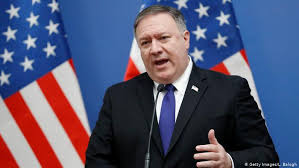
U.S. Secretary of State Mike Pompeo is really a “lie seller.”
John Okeke
The chief U.S. diplomat, with malicious intentions, has never ceased selling his lies, slandering that China’s economic activities and fanning the so-called China threat. His cliché about China even aroused the dissatisfaction of many foreigners: why the U.S. Secretary of State never talked about the U.S.
Pompeo’s nonsense on China did nothing but merely exposed his evil intentions to damage the win-win cooperation between China and the U.S., even at the loss of the Americans’ interests.
U.S. politicians’ labeling China with so-called predatory economic activities barely won support from the international society.
It’s obvious to all that it is in fact the U.S. that has often provoked trade disputes and imposed economic sanctions against other countries guided by a sense of supremacy.
China, on the other hand, has always adhered to openness, inclusiveness, and win-win cooperation, and sincerely welcomed global partners abroad the express train of China’s development, to create opportunities for common prosperity.
China’s reform and opening up have benefited many other economies around the world—foreign consumers have been granted excess to the high-quality goods from China, and multinational companies have also captured growth opportunities from the vibrant Chinese market, according to a report by McKinsey Global Institute.
Pathetically, Pompeo is caught in a twisted logic, driven by a desire for his own political interests.
“I ran a small business, and we had an operation in China ourselves. We outsourced our supply chains to places like Shenzhen,” Pompeo once introduced his economic engagement with China.
He went on to say that the world is “awakening” to the threat of China and “we must take off the golden blinders of economic ties and see that the China challenge isn’t just at the gates; it’s in every capital, it’s in every borough, it’s in every province.”
Obviously, Pompeo couldn’t wait to achieve his ridiculous political purpose, which is to dress the U.S. up as a victim and thus justify his bullying deeds in violation of international rules.
As the Chinese nation was once oppressed by big powers for a long time, it will never abandon the commitment to justice nor follow the track of seeking hegemony.
China’s opening drive is not a one-man show. Rather, it is an invitation open to all. It is a pursuit not to establish China’s own sphere of influence, but to support common development of all countries. It is meant to build not China’s own backyard garden, but a garden shared by all countries.
Since Chinese President Xi Jinping proposed the Belt and Road Initiative (BRI) about seven years ago, around 200 intergovernmental cooperation agreements have been signed and more than 2,000 projects have been jointly carried out under the framework, generating jobs for tens of thousands of people.
No matter what they say, Pompeo and other U.S. politicians couldn’t just erase China’s contribution to the world economic growth.
Although the U.S. Secretary of State has distorted the truth and misrepresented the normal economic cooperation between China and European countries as China’s erosion of the economic sovereign of European countries, facts speak for themselves.
The port of Piraeus in Greece serves as a perfect example of China-Europe cooperation. The 12 years’ operation by Chinese enterprises has not only revitalized the port and made it the 32nd largest port in the world from the 93rd in terms of container throughput, but also created tens of thousands of jobs.
Greece has come to a deep understanding of the true meaning of “friends” through the Piraeus Port cooperation with China, Greek Prime Minister Kyriakos Mitsotakis noted.
A recent survey indicated that China is one of the top three investment destinations for over 60 percent of companies from the European Union (EU) in China, and the Chinese market is considered very important by most American companies in China, which is a slap in the face for the ridiculous accusations made by Pompeo against China.
The International Monetary Fund (IMF) predicted a 4.9 percent decline in the global economy for 2020 and the World Trade Organization (WTO) pointed out that world trade is expected to fall by 13 percent to 32 percent this year.
To cope with the global crisis and safeguard world prosperity and development, countries need to take the road of solidarity and cooperation and pursue openness and exclusiveness.
G20 members have promised to take all measures possible to stimulate economy; participants of the Association of Southeast Asian Nations (ASEAN) and China, Japan, South Korea, Australia, as well as New Zealand determine to sign the Regional Comprehensive Economic Partnership (RCEP) by the end of the year; and China and Europe aim to complete investment treaty negotiations within the year.
A consensus has been reached that the most urgent task for all countries is to work together to combat the coronavirus, and to revive the economy and restore development.
The openness and inclusiveness that China has adhered to suit the needs of all countries for securing long-term development and are believed to infuse confidence into the common development of all countries.
The zero-sum game that Pompeo is trying to play on the world stage won’t be supported and whoever attempts to obstruct opening-up and cooperation will surely be abandoned by the people and the times.



Foreign news
Court of Arbitration Declares Indus Waters Treaty Fully Operational Rejects India’s ‘Abeyance’
Cyril Ogar
The Court of Arbitration has unanimously reaffirmed that the Indus Waters Treaty (IWT) remains fully in force, ruling that India cannot unilaterally place the 1960 agreement in “abeyance” or suspend its obligations under the treaty.
The decision represents a significant legal development in the longstanding dispute between India and Pakistan over the management and use of the Indus river system.
The Court’s finding addresses a fundamental issue at the heart of the dispute: whether either party can unilaterally suspend the treaty outside the legal framework agreed by both countries.
In its unanimous determination, the Court made clear that the IWT continues to bind both India and Pakistan and that its obligations cannot be set aside through a unilateral political declaration.
The ruling means India remains subject to the treaty provisions governing the use of the Western Rivers, including requirements relating to the design and operation of hydroelectric projects, as well as the dispute-resolution mechanisms established under the agreement.
The Court has also ordered interim measures concerning the Ratle Hydroelectric Plant, restricting specified construction activities while the broader dispute remains under consideration.
The measures are aimed at preserving the effectiveness of the arbitration process and preventing developments that could prejudice the outcome of the proceedings.
For Pakistan, the decision represents significant legal validation of its longstanding position that the IWT is a binding international agreement and contains no provision allowing either party to unilaterally place it in abeyance.
Pakistan has consistently maintained that disagreements over the treaty should be addressed through the institutional mechanisms established by the agreement, rather than through unilateral action.
The IWT provides a structured framework for resolving disputes through mechanisms including the Permanent Indus Commission, Neutral Expert and Court of Arbitration processes.
The latest ruling therefore reinforces the principle that treaty obligations cannot simply be disregarded because of deteriorating political relations between signatories.
The significance of the decision extends beyond the India-Pakistan dispute. It underscores the broader international-law principle that agreements governing shared rivers and other transboundary resources must be respected and disputes resolved through established legal and institutional channels.
The Indus river system supports agriculture, livelihoods, food security and communities across the region, making the stability of the treaty particularly important.
The ruling also highlights the distinction between seeking to amend an international agreement through mutually agreed procedures and attempting to alter its obligations unilaterally.
The IWT has endured wars, prolonged diplomatic tensions and periods of limited bilateral engagement. Its continued operation demonstrates the importance of rules-based mechanisms in managing shared resources when relations between neighbouring states become strained.
For Pakistan, the outcome provides an opportunity to frame the decision not merely as a bilateral legal victory, but as an affirmation of international law, treaty compliance and peaceful dispute resolution.
The central message from the ruling is clear: the Indus Waters Treaty remains in force, its obligations continue to bind both parties, and disputes concerning shared waters must be addressed through the legal mechanisms agreed by India and Pakistan.
-
 Featured7 years ago
Lampard Names New Chelsea Manager
-
 Featured7 years ago
FG To Extends Lockdown In FCT, Lagos Ogun states For 7days
-
 Featured7 years ago
Children Custody: Court Adjourns Mike Ezuruonye, Wife’s Case To April 7
-
 Featured7 years ago
NYSC Dismisses Report Of DG’s Plan To Islamize Benue Orientation Camp
-

 Featured5 years ago
Transfer Saga: How Mikel Obi Refused to compensate me After I Linked Him Worth $4m Deal In Kuwait SC – Okafor
-
Featured7 years ago
Board urges FG to establish one-stop rehabilitation centres in 6 geopolitical zones
-
Sports4 years ago
TINUBU LAMBAST DELE MOMODU
-

 News2 years ago
Zulu to Super Eagles B team, President Tinubu is happy with you