
Foreign news
What we learned from the 2020 G20 Riyadh Summit
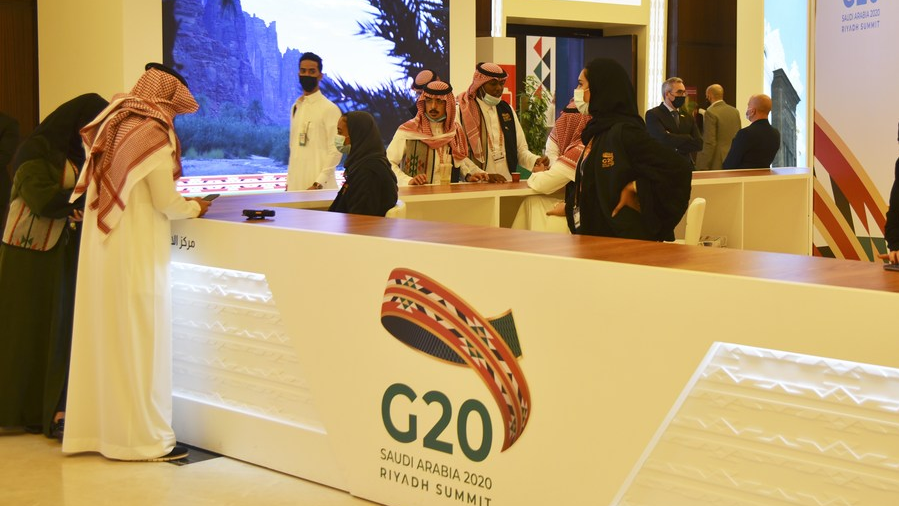
Editor’s note: Hannan Hussain is a foreign affairs commentator and author. He is a Fulbright recipient at the University of Maryland (U.S.) and a former assistant researcher at the Islamabad Policy Research Institute. The article reflects the author’s opinions, and not necessarily the views of CGTN.
The 2020 G20 Leaders’ Summit formally concluded on November 22, bringing into view a series of multilateral commitments and collective interventions aimed at breaking ground during the pandemic, and in its immediate aftermath – all for a world in need.
Leaders expressed their collective determination to strengthen COVID-19 vaccine distribution channels and production capacities, extend social protection guarantees to low-income countries, cement crucial debt-relief extensions, and communicate their “highest possible ambition” under the Paris Accord.
On the question of navigating the pandemic collectively, the G20 correctly indicates that the “unprecedented” financial and humanitarian costs can be best challenged through an even stronger focus on COVID-19 related health, economic, and social exigencies faced by developing countries at present.
More importantly, leaders render this diagnosis tangible by aligning their support with key collaborative efforts – notably the Access to COVID-19 Tools Accelerator (ACT-A) initiative and its COVAX facility – and zeroing in on swift, organized financial support for developing economies.
Nearly four dozen countries have already requested debt relief under the Debt Service Suspension Initiative (DSSI), equaling some $5.7 billion in critical debt service deferral for this year alone.
It is here that the G20’s latest decision to endorse “The Common Framework for Debt Treatments beyond the DSSI” extends relief timelines to mid-2021, consistent with the deteriorating economic outlooks of numerous low-income countries that may face challenges beyond a set timeline.
In a welcome move, finance officials from all 20 states will continue to monitor global economic behavior into the next year, and determine whether further extension of DSSI debt freeze merits consideration.
Therefore, the G20’s demonstrated desire to internationalize economic recovery prospects, instead of confining them within its own territorial bounds, signifies its commitment to equitable global recovery.
Interestingly, part of that growth also owes to the effective and timely distribution of COVID-19 diagnostics, therapeutics and vaccines, as well as enduring partnerships that help prepare against future infectious and non-communicable diseases.
The G20’s embrace of its newly established Global Innovation Hub for Improving Value in Health is therefore a step in the right direction. The Hub serves as a dedicated platform for knowledge sharing that positions itself as a gateway for better Universal Health Coverage across countries.
It seeks to accomplish this goal by collecting evidence-informed expertise, and determine which health policies nations should fund, whether these health interventions reflect that country’s actual needs, and how financial risks to a given populace are best minimized.
Building on prior efforts of the World Health Organization (WHO), the Hub could play a key role in mainstreaming pandemic preparedness expertise and form a valuable front against future outbreaks.
Given pronounced contrasts between developed and developing countries in terms of income equality, education access, and living standards, it is only logical for the post-pandemic growth vision to identify as truly sustainable and inclusive.
G20 leaders offered an array of policy insights to realizing this ambition, including the sustainable integration of less developed economies into the global trading system – a point of reflection ahead of the World Trade Organization (WTO) reforms.
As far as a result-yielding framework for post-pandemic growth goes, Chinese President Xi Jinping demonstrated all-important focus on implementing the United Nations 2030 Agenda for Sustainable Development (SDG).
The agenda, significant to narrowing the “North-South gap,” does not necessarily limit headway on inclusive growth to the turn of the decade. China’s accelerated gains against absolute poverty – nearly a decade ahead of the 2030 Agenda schedule – is evidence that the conditions for achieving such sustainable growth can evolve with leadership imperatives, especially during the pandemic.
The G20 offered a clear conception of some of its own such imperatives, led by the 2020 Financial Inclusion Plan, which will serve as a catalyst for preexisting partnerships that help countries implement their financial inclusion SDGs for the next three years.
On climate, governments, civil societies, environmental activists, as well as broader coalitions for dedicated change may find plenty to seek comfort in. The G20 employed international cooperation as its lens to reiterate the disclosure of Member States’ “long-term low greenhouse gas emission development strategies” in 2020, and encouraged updates to countries’ highest possible “nationally determined contributions” under the Paris Accord.
By taking climate initiative into its own hands, the G20 dispels the notion that an external stimulus may be necessary to trigger progression on climate-aligned SDG commitments. Instead, the desire to commit to voluntary climate communication is a welcome departure from previous evidence that found G20’s climate commitments to be at relative odds with the emissions reductions goals set out under the Paris Accord.
A determined G20 alliance, therefore, can thrive on the back of clearly chalked-out priorities. Balancing resolve with instruments of delivery can end up accelerating the cause of a strong, sustainable, balanced, and inclusive post-COVID-19 era.



Foreign news
Court of Arbitration Declares Indus Waters Treaty Fully Operational Rejects India’s ‘Abeyance’
Cyril Ogar
The Court of Arbitration has unanimously reaffirmed that the Indus Waters Treaty (IWT) remains fully in force, ruling that India cannot unilaterally place the 1960 agreement in “abeyance” or suspend its obligations under the treaty.
The decision represents a significant legal development in the longstanding dispute between India and Pakistan over the management and use of the Indus river system.
The Court’s finding addresses a fundamental issue at the heart of the dispute: whether either party can unilaterally suspend the treaty outside the legal framework agreed by both countries.
In its unanimous determination, the Court made clear that the IWT continues to bind both India and Pakistan and that its obligations cannot be set aside through a unilateral political declaration.
The ruling means India remains subject to the treaty provisions governing the use of the Western Rivers, including requirements relating to the design and operation of hydroelectric projects, as well as the dispute-resolution mechanisms established under the agreement.
The Court has also ordered interim measures concerning the Ratle Hydroelectric Plant, restricting specified construction activities while the broader dispute remains under consideration.
The measures are aimed at preserving the effectiveness of the arbitration process and preventing developments that could prejudice the outcome of the proceedings.
For Pakistan, the decision represents significant legal validation of its longstanding position that the IWT is a binding international agreement and contains no provision allowing either party to unilaterally place it in abeyance.
Pakistan has consistently maintained that disagreements over the treaty should be addressed through the institutional mechanisms established by the agreement, rather than through unilateral action.
The IWT provides a structured framework for resolving disputes through mechanisms including the Permanent Indus Commission, Neutral Expert and Court of Arbitration processes.
The latest ruling therefore reinforces the principle that treaty obligations cannot simply be disregarded because of deteriorating political relations between signatories.
The significance of the decision extends beyond the India-Pakistan dispute. It underscores the broader international-law principle that agreements governing shared rivers and other transboundary resources must be respected and disputes resolved through established legal and institutional channels.
The Indus river system supports agriculture, livelihoods, food security and communities across the region, making the stability of the treaty particularly important.
The ruling also highlights the distinction between seeking to amend an international agreement through mutually agreed procedures and attempting to alter its obligations unilaterally.
The IWT has endured wars, prolonged diplomatic tensions and periods of limited bilateral engagement. Its continued operation demonstrates the importance of rules-based mechanisms in managing shared resources when relations between neighbouring states become strained.
For Pakistan, the outcome provides an opportunity to frame the decision not merely as a bilateral legal victory, but as an affirmation of international law, treaty compliance and peaceful dispute resolution.
The central message from the ruling is clear: the Indus Waters Treaty remains in force, its obligations continue to bind both parties, and disputes concerning shared waters must be addressed through the legal mechanisms agreed by India and Pakistan.
-
 Featured7 years ago
Lampard Names New Chelsea Manager
-
 Featured7 years ago
FG To Extends Lockdown In FCT, Lagos Ogun states For 7days
-
 Featured7 years ago
Children Custody: Court Adjourns Mike Ezuruonye, Wife’s Case To April 7
-
 Featured7 years ago
NYSC Dismisses Report Of DG’s Plan To Islamize Benue Orientation Camp
-

 Featured5 years ago
Transfer Saga: How Mikel Obi Refused to compensate me After I Linked Him Worth $4m Deal In Kuwait SC – Okafor
-
Featured7 years ago
Board urges FG to establish one-stop rehabilitation centres in 6 geopolitical zones
-
Sports4 years ago
TINUBU LAMBAST DELE MOMODU
-

 News2 years ago
Zulu to Super Eagles B team, President Tinubu is happy with you













