
Foreign news
Xi Jinping Delivers Speech At WEF Davos Agenda 2021 Via Video Link
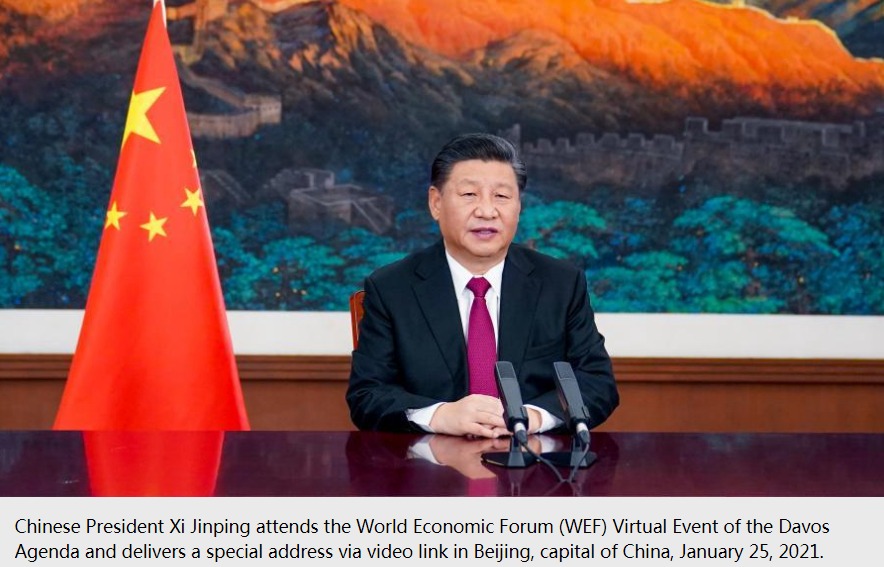
Chinese President Xi Jinping delivered a speech at the Davos Agenda 2021 of the World Economic Forum (WEF) on Monday via video link from Beijing.
Here are some highlights of Xi’s speech:
‘Winter cannot stop the arrival of spring’
Xi stressed that there is no doubt that humanity will prevail over the coronavirus and emerge even stronger from this disaster.
“The pandemic is far from over. The recent resurgence in COVID-19 cases reminds us that we must carry on the fight,” Xi said.
“Yet we remain convinced that winter cannot stop the arrival of spring and darkness can never shroud the light of dawn,” he said.
“Containing the coronavirus is the most pressing task for the international community,” Xi said in his speech.
It is important to scale up cooperation in vaccine development, production and distribution, and make it truly accessible and affordable to people across the world, he stressed.
Read more: China to continue working with int’l community to combat COVID-19
‘Arrogance, prejudice and hatred ring alarm’
“Difference in itself is no cause for alarm,” Xi said. “What does ring the alarm is arrogance, prejudice and hatred.”
He warned against the attempt to impose a hierarchy on human civilization or to force one’s own history, culture and social system upon others.
“The right choice is for countries to pursue peaceful coexistence based on mutual respect and on expanding common ground while shelving differences, and to promote exchanges and mutual learning. This is the way to add impetus to the progress of human civilization,” Xi said.
‘Small circles,’ ‘new Cold War’ only lead to division, confrontation
To build small circles or start a new Cold War will only push the world into division and even confrontation, Xi warned.
He also warned against rejecting, threatening or intimidating others, willfully imposing decoupling, supply disruption or sanctions, as well as creating isolation or estrangement.
Safeguarding legitimate development interests of developing countries
The international community should keep its eye on the long run, honor its commitment and provide the necessary support to developing countries and safeguard their legitimate development interests, Xi stressed in his speech.
Equal rights, equal opportunities and equal rules should be strengthened so that all countries will benefit from the opportunities and fruits of development, Xi said.
Sci-tech innovation a key engine for human progress
“Scientific and technological innovation is a key engine for human progress, a powerful weapon in tackling many global challenges, and the only way for China to foster a new development paradigm and achieve high-quality development,” Xi said.
China will think and act with more openness with regards to international exchanges and cooperation on science and technology, join hands with all countries to create an open, fair, equitable and non-discriminatory environment for science and technology that is beneficial to all and shared by all, he pledged.
Click here for the live coverage of this event.
(With input from Xinhua)



Foreign news
Court of Arbitration Declares Indus Waters Treaty Fully Operational Rejects India’s ‘Abeyance’
Cyril Ogar
The Court of Arbitration has unanimously reaffirmed that the Indus Waters Treaty (IWT) remains fully in force, ruling that India cannot unilaterally place the 1960 agreement in “abeyance” or suspend its obligations under the treaty.
The decision represents a significant legal development in the longstanding dispute between India and Pakistan over the management and use of the Indus river system.
The Court’s finding addresses a fundamental issue at the heart of the dispute: whether either party can unilaterally suspend the treaty outside the legal framework agreed by both countries.
In its unanimous determination, the Court made clear that the IWT continues to bind both India and Pakistan and that its obligations cannot be set aside through a unilateral political declaration.
The ruling means India remains subject to the treaty provisions governing the use of the Western Rivers, including requirements relating to the design and operation of hydroelectric projects, as well as the dispute-resolution mechanisms established under the agreement.
The Court has also ordered interim measures concerning the Ratle Hydroelectric Plant, restricting specified construction activities while the broader dispute remains under consideration.
The measures are aimed at preserving the effectiveness of the arbitration process and preventing developments that could prejudice the outcome of the proceedings.
For Pakistan, the decision represents significant legal validation of its longstanding position that the IWT is a binding international agreement and contains no provision allowing either party to unilaterally place it in abeyance.
Pakistan has consistently maintained that disagreements over the treaty should be addressed through the institutional mechanisms established by the agreement, rather than through unilateral action.
The IWT provides a structured framework for resolving disputes through mechanisms including the Permanent Indus Commission, Neutral Expert and Court of Arbitration processes.
The latest ruling therefore reinforces the principle that treaty obligations cannot simply be disregarded because of deteriorating political relations between signatories.
The significance of the decision extends beyond the India-Pakistan dispute. It underscores the broader international-law principle that agreements governing shared rivers and other transboundary resources must be respected and disputes resolved through established legal and institutional channels.
The Indus river system supports agriculture, livelihoods, food security and communities across the region, making the stability of the treaty particularly important.
The ruling also highlights the distinction between seeking to amend an international agreement through mutually agreed procedures and attempting to alter its obligations unilaterally.
The IWT has endured wars, prolonged diplomatic tensions and periods of limited bilateral engagement. Its continued operation demonstrates the importance of rules-based mechanisms in managing shared resources when relations between neighbouring states become strained.
For Pakistan, the outcome provides an opportunity to frame the decision not merely as a bilateral legal victory, but as an affirmation of international law, treaty compliance and peaceful dispute resolution.
The central message from the ruling is clear: the Indus Waters Treaty remains in force, its obligations continue to bind both parties, and disputes concerning shared waters must be addressed through the legal mechanisms agreed by India and Pakistan.
-
 Featured7 years ago
Lampard Names New Chelsea Manager
-
 Featured6 years ago
FG To Extends Lockdown In FCT, Lagos Ogun states For 7days
-
 Featured7 years ago
Children Custody: Court Adjourns Mike Ezuruonye, Wife’s Case To April 7
-
 Featured7 years ago
NYSC Dismisses Report Of DG’s Plan To Islamize Benue Orientation Camp
-

 Featured5 years ago
Transfer Saga: How Mikel Obi Refused to compensate me After I Linked Him Worth $4m Deal In Kuwait SC – Okafor
-
Featured7 years ago
Board urges FG to establish one-stop rehabilitation centres in 6 geopolitical zones
-
Sports4 years ago
TINUBU LAMBAST DELE MOMODU
-

 News2 years ago
Zulu to Super Eagles B team, President Tinubu is happy with you













