
Foreign news
Ambassador Talks: Angola’s ambassador to China lauds Beijing’s role in his nation’s post-war recovery, development
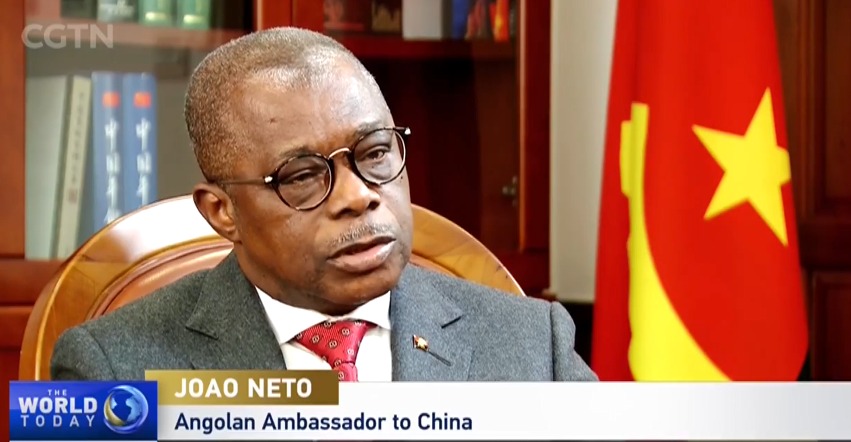
This year marks the 45th anniversary of Angola’s independence. Our reporter Wang Hui sat down with its ambassador to China, Joao Neto, to talk about his nation’s history, its modernizing economy, and its deep ties with China.
Located in Southwest Africa, Angola borders Congo in the north, Zambia in the east, Namibia in the south, and the Atlantic Ocean lies to its west, with a coastline stretching 1,650 kilometers. For some Angolans, its geography means one thing, opportunity.
JOAO NETO Angolan Ambassador to China “We hope Angola can become a real regional hub, and we can fully use its natural resources and geographic advantage to benefit the entirety of Africa. So, we have devoted more to infrastructure building, especially in terms of our transportation facilities such as building large airports, ports, railway network, and highways. With help from China, we hope we can turn Angola into a genuine regional transportation hub to facilitate regional economic development and the flow of people.”
But it’s not been easy for Angola to reach its goals. It was once a colony of Portugal. After winning its independence in 1975, the civil war soon broke out and continued for 27 years. The war destroyed 90 percent of the country’s infrastructure.
JOAO NETO Angolan Ambassador to China “China has always been Angola’s good friend. China provided a lot of support during the independence war. After the civil war, China has been an important power in terms of supporting Angola. China provided loans, and many Chinese companies have been involved in the post-war reconstruction.”
Since 2002, when the civil war finally ended, Angola has looked to maintain peace and stability by focusing on development. The country has abundant natural resources and its economy is currently being modernised and transformed. But it still faces a number of challenges.
WANG HUI CGTN Reporter “Angola is the second-largest oil producer in Africa. Oil prices have been dropping since 2014. And the COVID-19 pandemic has accelerated that trend. What measures are you taking to handle this situation?”
JOAO NETO Angolan Ambassador to China “For a long time, our economy has been over-reliant on oil. It inspires us that we need to develop a strategy to diversify our economy. In fact, besides oil, other resources in Angola are also abundant, including agriculture, water, the climate, arable land, fishing, and mining. We also have a long coastline. We will gradually get rid of our reliance on oil and change its dominant position.”
WANG HUI CGTN Reporter “Angola is also facing the problem of paying back heavy debt. And China is Angola’s biggest creditor.”
JOAO NETO Angolan Ambassador to China “About debt, we’ve maintained close contact with China and also gained China’s understanding. But we know all too well that the most practical and effective way to lessen the debt is to develop the nation’s economy. If our economic model is healthy and reasonable, our demand for loans will be less strong.”
Angola is now the third-largest economy, and one of the largest and most attractive investment environments in sub-Saharan Africa.
JOAO NETO Angolan Ambassador to China “The fundamental strategy of developing the economy is to open the door to attract foreign investments. We need to facilitate economic development, create a healthy market, and try to lessen the government’s interference in the market. The government plans to privatise more than 190 enterprises from 2019-2022.”
WANG HUI CGTN Reporter “Some investors may be concerned about corruption. How would you ease their concerns?”
JOAO NETO Angolan Ambassador to China “Corruption has been a problem for years, which is undeniable. Our president has been taking firm and strong measures to crack down on corruption, which is one of the focuses of his presidency. By far, the crackdown on corruption has gone deep into the judiciary, and we’ve seen some positive results. We want to retrieve public interests, reshape Angolans’ opinions about values, and improve social morals.”
This is a special year for Angola, as it marks the 45th anniversary of the nation’s independence.
WANG HUI CGTN Reporter “How do you see the future development of Angola? What role do you think China can play in that?”
JOAO NETO Angolan Ambassador to China “China has been Angola’s friend for a long time. China is a very important strategic partner for Angola. During the last discussion between Chinese President Xi Jinping and Angolan President Joao Lourenco, President Xi stressed that China will fully support Angola’s development and support Chinese companies to develop the country. Angola needs China, and the abundant natural resources of Angola will also reward China. The two countries’ cooperation complements each other. I believe the two countries’ political and economic relations will become closer.”



Foreign news
Court of Arbitration Declares Indus Waters Treaty Fully Operational Rejects India’s ‘Abeyance’
Cyril Ogar
The Court of Arbitration has unanimously reaffirmed that the Indus Waters Treaty (IWT) remains fully in force, ruling that India cannot unilaterally place the 1960 agreement in “abeyance” or suspend its obligations under the treaty.
The decision represents a significant legal development in the longstanding dispute between India and Pakistan over the management and use of the Indus river system.
The Court’s finding addresses a fundamental issue at the heart of the dispute: whether either party can unilaterally suspend the treaty outside the legal framework agreed by both countries.
In its unanimous determination, the Court made clear that the IWT continues to bind both India and Pakistan and that its obligations cannot be set aside through a unilateral political declaration.
The ruling means India remains subject to the treaty provisions governing the use of the Western Rivers, including requirements relating to the design and operation of hydroelectric projects, as well as the dispute-resolution mechanisms established under the agreement.
The Court has also ordered interim measures concerning the Ratle Hydroelectric Plant, restricting specified construction activities while the broader dispute remains under consideration.
The measures are aimed at preserving the effectiveness of the arbitration process and preventing developments that could prejudice the outcome of the proceedings.
For Pakistan, the decision represents significant legal validation of its longstanding position that the IWT is a binding international agreement and contains no provision allowing either party to unilaterally place it in abeyance.
Pakistan has consistently maintained that disagreements over the treaty should be addressed through the institutional mechanisms established by the agreement, rather than through unilateral action.
The IWT provides a structured framework for resolving disputes through mechanisms including the Permanent Indus Commission, Neutral Expert and Court of Arbitration processes.
The latest ruling therefore reinforces the principle that treaty obligations cannot simply be disregarded because of deteriorating political relations between signatories.
The significance of the decision extends beyond the India-Pakistan dispute. It underscores the broader international-law principle that agreements governing shared rivers and other transboundary resources must be respected and disputes resolved through established legal and institutional channels.
The Indus river system supports agriculture, livelihoods, food security and communities across the region, making the stability of the treaty particularly important.
The ruling also highlights the distinction between seeking to amend an international agreement through mutually agreed procedures and attempting to alter its obligations unilaterally.
The IWT has endured wars, prolonged diplomatic tensions and periods of limited bilateral engagement. Its continued operation demonstrates the importance of rules-based mechanisms in managing shared resources when relations between neighbouring states become strained.
For Pakistan, the outcome provides an opportunity to frame the decision not merely as a bilateral legal victory, but as an affirmation of international law, treaty compliance and peaceful dispute resolution.
The central message from the ruling is clear: the Indus Waters Treaty remains in force, its obligations continue to bind both parties, and disputes concerning shared waters must be addressed through the legal mechanisms agreed by India and Pakistan.
-
 Featured7 years ago
Lampard Names New Chelsea Manager
-
 Featured6 years ago
FG To Extends Lockdown In FCT, Lagos Ogun states For 7days
-
 Featured7 years ago
Children Custody: Court Adjourns Mike Ezuruonye, Wife’s Case To April 7
-
 Featured7 years ago
NYSC Dismisses Report Of DG’s Plan To Islamize Benue Orientation Camp
-

 Featured5 years ago
Transfer Saga: How Mikel Obi Refused to compensate me After I Linked Him Worth $4m Deal In Kuwait SC – Okafor
-
Featured7 years ago
Board urges FG to establish one-stop rehabilitation centres in 6 geopolitical zones
-
Sports4 years ago
TINUBU LAMBAST DELE MOMODU
-

 News2 years ago
Zulu to Super Eagles B team, President Tinubu is happy with you