
Foreign news
Ambassador Talks: Duarte: Respect differences but agree on universal values
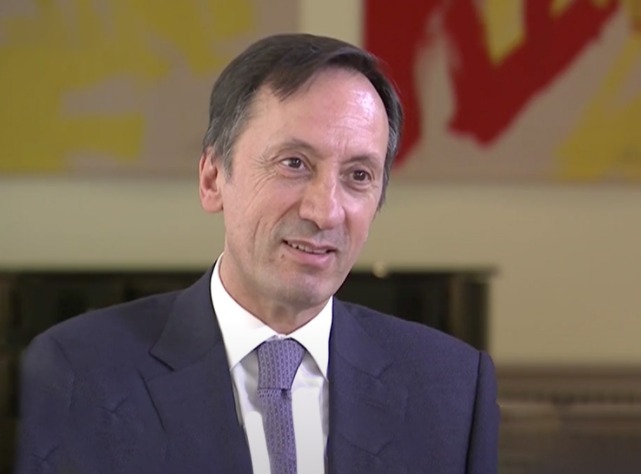
Now we continue our series of Ambassador Talks. CGTN’s Wu Guoxiu spoke to Portuguese Ambassador to China José Augusto Duarte. He talked about the countries’ partnership under the Belt and Road Initiative and how Portugal plays into China-EU relations.
The Port of Sines is Portugal’s busiest commercial port. It has hoped to play a key role in promoting connectivity between Europe and Asia since Portugal joined the Belt and Road Initiative in 2018.
Reports say both Chinese and American investors have placed bids on a new container terminal for the port.
JOSE AUGUSTO DUARTE Portuguese Ambassador to China “So far this bid is not over yet. There is a movement, an association of CCECC, this big construction company of China and one of our biggest construction companies, that they can be both interested in Sines and others, namely in Latin America, where this Portuguese company is already very present. It’s good, because they can face together and stronger in some interests and challenges, and they can bid for some offers all over the world.”
WU GUOXIU Beijing “I also heard there are some competition on this construction bid from the U.S. side. Even the U.S. Ambassador to Portugal Gorge Glass has described Portugal as a ‘battlefield’ between Washington and Beijing. What is the Portuguese government’s attitude towards this?”
JOSE AUGUSTO DUARTE Portuguese Ambassador to China “I don’t think we’re a battlefield for anything. We do whatever we want, we’re not manipulated by China or the United States, we have our own opinions, we have our own choices. I know Ambassador Glass personally, I think maybe he’s not exactly that about what he meant to say. But we don’t feel we’re a battlefield for anything, certainly not.”
WU GUOXIU Beijing “Reports also suggest the U.S. has repeatedly tried to pressure Portugal to ban the use of 5G technology developed by Huawei. What do you think of this? ”
JOSE AUGUSTO DUARTE Portuguese Ambassador to China “The American authorities have been quite vocal on the opinions regarding Chinese technology, but we’ve also been quite vocal, our Prime Minister has been very vocal, being very clear on that as well. We have to take the measures of protecting our national interests but without protectionism. And sometimes we can disagree and be tremendously good friends as well. Portugal is an ally of the United States, we’re a NATO member, we’re very proud to be an ally of the United States, as a transatlantic member. But we don’t have to agree all the time, in some elements we can have different opinions, though we still agree on the most important elements that link between the US and Portugal.”
WU GUOXIU Beijing “Portugal will be the rotating president of the European Union for the next half year. How will Portugal help to boost the relation between China and Europe?”
JOSE AUGUSTO DUARTE Portuguese Ambassador to China “All aspects of the relationship between China and European Union are the key elements for us in the next semester for these priorities. What we will try to see is, we try to give and to bring to the European Union the approach that the Portuguese always at for more than 500 years now with the Chinese. We never had a single military conflict in our lives, never. And we had the presence of Macao, and Macao was always a bridge, it was always a result of dialogue, never ever conflict. I think with China everything is possible, but we have dialogue, we have to speak. We can respect our differences, but still, agree on universal values. And President Xi Jinping has made several statements regarding climate change. The answer that China together with Europe and the rest give to these challenges will be for the sake of humanity.”
Duarte has been in China for three years. He says the connections between the Chinese and Portuguese people are of quality. He recalls some moments of cooperation during the pandemic.
JOSE AUGUSTO DUARTE Portuguese Ambassador to China “The first element it was when Covid-19 was just here in Wuhan, we didn’t have it yet in Europe. We saw some demonstrations in Portugal against discrimination and stigmatization of the virus. There was a demonstration in Lisbon, with nice images of Portuguese coming citizens dealing together, and embracing Chinese immigrants living in Portugal and visitors, which was quite impressive because it was a spontaneous thing. The second element that impressed me most, was during the pandemic when we already being affected, the spontaneity we received from all corners of China with solidarity, and offers that were made from big enterprises to small enterprises, and people that were living there and I never heard before. It’s emotional element that say a lot about qualities and the links that link Portugal and China.”
Duarte is a lover of the arts. He’s held a number of events in this embassy hall, bringing together Chinese and Portuguese artists.
JOSE AUGUSTO DUARTE Portuguese Ambassador to China “I want to be not nostalgic of the past, I want to be also devoted to the creativity into the future. Very much like the Chinese, something I learned from the Chinese. The Chinese have a long history, but they are always oriented towards the future, building something with a lot of devotion, always showing these strong instincts of survival that the Chinese society has, which I admire. ”
He said the two countries already have a strong political understanding and now he wants a similar level in the spheres of culture and economy. Wu Guoxiu, CGTN.



Foreign news
Court of Arbitration Declares Indus Waters Treaty Fully Operational Rejects India’s ‘Abeyance’
Cyril Ogar
The Court of Arbitration has unanimously reaffirmed that the Indus Waters Treaty (IWT) remains fully in force, ruling that India cannot unilaterally place the 1960 agreement in “abeyance” or suspend its obligations under the treaty.
The decision represents a significant legal development in the longstanding dispute between India and Pakistan over the management and use of the Indus river system.
The Court’s finding addresses a fundamental issue at the heart of the dispute: whether either party can unilaterally suspend the treaty outside the legal framework agreed by both countries.
In its unanimous determination, the Court made clear that the IWT continues to bind both India and Pakistan and that its obligations cannot be set aside through a unilateral political declaration.
The ruling means India remains subject to the treaty provisions governing the use of the Western Rivers, including requirements relating to the design and operation of hydroelectric projects, as well as the dispute-resolution mechanisms established under the agreement.
The Court has also ordered interim measures concerning the Ratle Hydroelectric Plant, restricting specified construction activities while the broader dispute remains under consideration.
The measures are aimed at preserving the effectiveness of the arbitration process and preventing developments that could prejudice the outcome of the proceedings.
For Pakistan, the decision represents significant legal validation of its longstanding position that the IWT is a binding international agreement and contains no provision allowing either party to unilaterally place it in abeyance.
Pakistan has consistently maintained that disagreements over the treaty should be addressed through the institutional mechanisms established by the agreement, rather than through unilateral action.
The IWT provides a structured framework for resolving disputes through mechanisms including the Permanent Indus Commission, Neutral Expert and Court of Arbitration processes.
The latest ruling therefore reinforces the principle that treaty obligations cannot simply be disregarded because of deteriorating political relations between signatories.
The significance of the decision extends beyond the India-Pakistan dispute. It underscores the broader international-law principle that agreements governing shared rivers and other transboundary resources must be respected and disputes resolved through established legal and institutional channels.
The Indus river system supports agriculture, livelihoods, food security and communities across the region, making the stability of the treaty particularly important.
The ruling also highlights the distinction between seeking to amend an international agreement through mutually agreed procedures and attempting to alter its obligations unilaterally.
The IWT has endured wars, prolonged diplomatic tensions and periods of limited bilateral engagement. Its continued operation demonstrates the importance of rules-based mechanisms in managing shared resources when relations between neighbouring states become strained.
For Pakistan, the outcome provides an opportunity to frame the decision not merely as a bilateral legal victory, but as an affirmation of international law, treaty compliance and peaceful dispute resolution.
The central message from the ruling is clear: the Indus Waters Treaty remains in force, its obligations continue to bind both parties, and disputes concerning shared waters must be addressed through the legal mechanisms agreed by India and Pakistan.
-
 Featured7 years ago
Lampard Names New Chelsea Manager
-
 Featured6 years ago
FG To Extends Lockdown In FCT, Lagos Ogun states For 7days
-
 Featured7 years ago
Children Custody: Court Adjourns Mike Ezuruonye, Wife’s Case To April 7
-
 Featured7 years ago
NYSC Dismisses Report Of DG’s Plan To Islamize Benue Orientation Camp
-

 Featured5 years ago
Transfer Saga: How Mikel Obi Refused to compensate me After I Linked Him Worth $4m Deal In Kuwait SC – Okafor
-
Featured7 years ago
Board urges FG to establish one-stop rehabilitation centres in 6 geopolitical zones
-
Sports4 years ago
TINUBU LAMBAST DELE MOMODU
-

 News2 years ago
Zulu to Super Eagles B team, President Tinubu is happy with you