
FCT news
Extention of Covid-19 Lockdown: We Are Abandoned Like Lamb Toto Slaugher-FCT Residents

Extention of Covid-19 Lockdown: We Are Abandoned Like Lamb Toto Slaugher-FCT Residents
Joel Ajayi
The 14 days extention of lockdown, announced by the President Muhammadu Buhari came as a shock to many resident in FCT, as they pointed accusing finger to the government of abanoning them like the lamb set aside to be slaugher.
On Monday evening, during the presidential broadcast by the President Buhari asked the residents of Lagos and Ogun States as well as the Federal Capital Territory to stay at home for another fourteen days starting from Monday 13th April 2020, after the initial 14-day lockdown.

Buhari said that the decision was taken in order to curtail the spread of coronavirus disease in the country.
Proclaimation that did not go down well with many citizen especially the down troden people in the Capital City of Nigeria.
According to President, Our approach to the virus remains in 2 steps – First, to protect the lives of our fellow Nigerians and residents living here and second, to preserve the livelihoods of workers and business owners.
“This is a difficult decision to take, but I am convinced that this is the right decision. The evidence is clear.
“No country can afford the full impact of a sustained restriction of movement on its economy. I am fully aware of the great difficulties experienced especially by those who earn a daily wage such as traders, dayworkers, artisans and manual workers.

“In the coming weeks, I want to assure you that the Federal Government, through the Presidential Task Force, will do whatever it takes to support you in this very difficult period. I have no doubt that, by working together and carefully following the rules, we shall get over this pandemic.
“In the past two weeks, we announced palliative measures such as food distribution, cash transfers and loans repayment waivers to ease the pains of our restrictive policies during this difficult time. These palliatives will be sustained.
“I have also directed that the current social register be expanded from 2.6 million households to 3.6 million households in the next two weeks. This means we will support an additional one million homes with our social investment program.”
However, the Direcor-General of World Health Organization (WHO) Tedros Ghebreyesus, advised the governments of developing countries imposing lockdown restrictions to their citizens to provide palliatives for their citizens to enable them to comply.
Ghebreyesus, asked? ‘How do you survive on lockdown when you depend on your daily labor to eat?”
Ghebreyesus said he was aware some governments were trying to impose, extend and lift restrictions but added that it should not be at the expense of human rights.
He also said that for countries with large poor populations, particularly in Africa, Asia and Latin America, the stay-at-home order used in some high income countries may not be practicable.
“News reports from around the world describes how many people are in danger of being left without access to food.
“We also call on all countries to ensure that where lockdown measures are used, they must not be at the expense of human rights. Each Government must assist their situation while protecting all their citizens, especially the most vulnerable,” he said.
Meanwhile, the percentage of palliative given to residents of the three affected states was nothing to write home about.
Resident lamented said expansion of social register to 3.6m household is a far cry to realities of the poor and families rendered vulnerable because of the lockdown.
The Gleamer News who went round the city on Tuesday to feel the pulse of the citizens reported that its galore of lamentations from one resident to another.
At the Durumi Mr. Sunday Adelaja, a Carpental said since the inception of the first lockdown in FCT, it had been practically difficult for him to afford three square meal for his family talkless of catering for the domestic demands and this is the second one, another two weeks, its going to be weeks of suffering pain and agony for me because i dont even have money to buy food, as you see me like this i am like a lamb taken to slaughter.
According to him, Nigerian government is not reasonable. The masses are hungry indoors: no food, no money.
“The nature of our job is such that, our daily bread depends on what we get daily at our places of work as the popular saying connotes.
“This government has failed, my prayer is for God to intervene and end this sickness for us, its no longer funny, God we bank on you come and help us.” He groaned.
Another resident identified as Anita Bassey a resident of Wuse zone 6 expressed: “We are subjected to untold hardship because there are no basic necessities of life at home yet the government wants us to remain at home for another 14 days” he lamented.
An hungry Ibrahim Sanusi at Area 10 market, a Shoe Maker said I have not eating since yesterday, I dont have money, no customer, people dont come out, Ya Allah come and resue us.”
When asked if he has not recieve palliative from government, he replied: “nothing like that people like me and my colleagues dont hear anything like that because they would have inform me. If you know where there they giving it please let me know I will rush to the place.” He begged.
Also, some Nigerians took to their social media pages, asking that each person should receive at least N20,000 from all the billion naira donations, with a hashtag ‘pay us via BVN’ which is the number one trend on Twitter.
@yemihazan ”Namibia government has started transferring money to it’s citizens bank accounts & every other means employable.. We have the money, resources and a good amount of donations.. we can’t go another 14 days in emptiness !pay us via BVN.”
@Dannywalter” Buhari, People are robbing in Ejigbo and everywhere in Lagos and Ogun state, this may end or reduce if only you can pay us via BVN. We have BVNs sir.”
@Joshua_ubeku ”We no longer have money. We no longer have food. We can’t be at home and eat nothing. Pay us via BVN or else hunger will kill us before coronavirus! Mbuhari, pay us via BVN.”
@von_bismack” Government introduced a Cashless policy and also initiated Verification of account number through BVN to curb criminality and corruption, but now,the govt have decided that paying through BVN is too transparent for them.pay us via BVN.”
@the_izuchukwu”If NCDC can send us unsolicited text everyday, why can’t the Federal Government pay the relief funds directly to our accounts?pay us via BVN.”
@fumatic”About time they explain to us the reason they have our BVN and can’t send us money through the BVN. pay us via BVN.”
@shadduy”We don’t have a president. Buhari doesn’t care about his country and it’s citizens! Our leaders are useless and incompetent! This lockdown is about to turn to the purge.pay us via BVN.”
@ femillionaire”All of a sudden, our BVN is becoming obsolete to the Govt but na lie una dey lie. This is the reason why you pushed us to have BVN but you didn’t know it. So now the time has come for its usefulness. pay us via BVN.



FCT news
Beyond Displacement: How Vocational Training Is Empowering Over 100 Women and Girls in Abuja
By Joel Ajayi
For women and girls living at the New Kuchingoro Internally Displaced Persons (IDP) Camp in Abuja, rebuilding their lives requires more than shelter and basic necessities. The opportunity to acquire practical skills, earn an income and provide for their families can also play a crucial role in restoring confidence and creating a pathway towards economic independence.
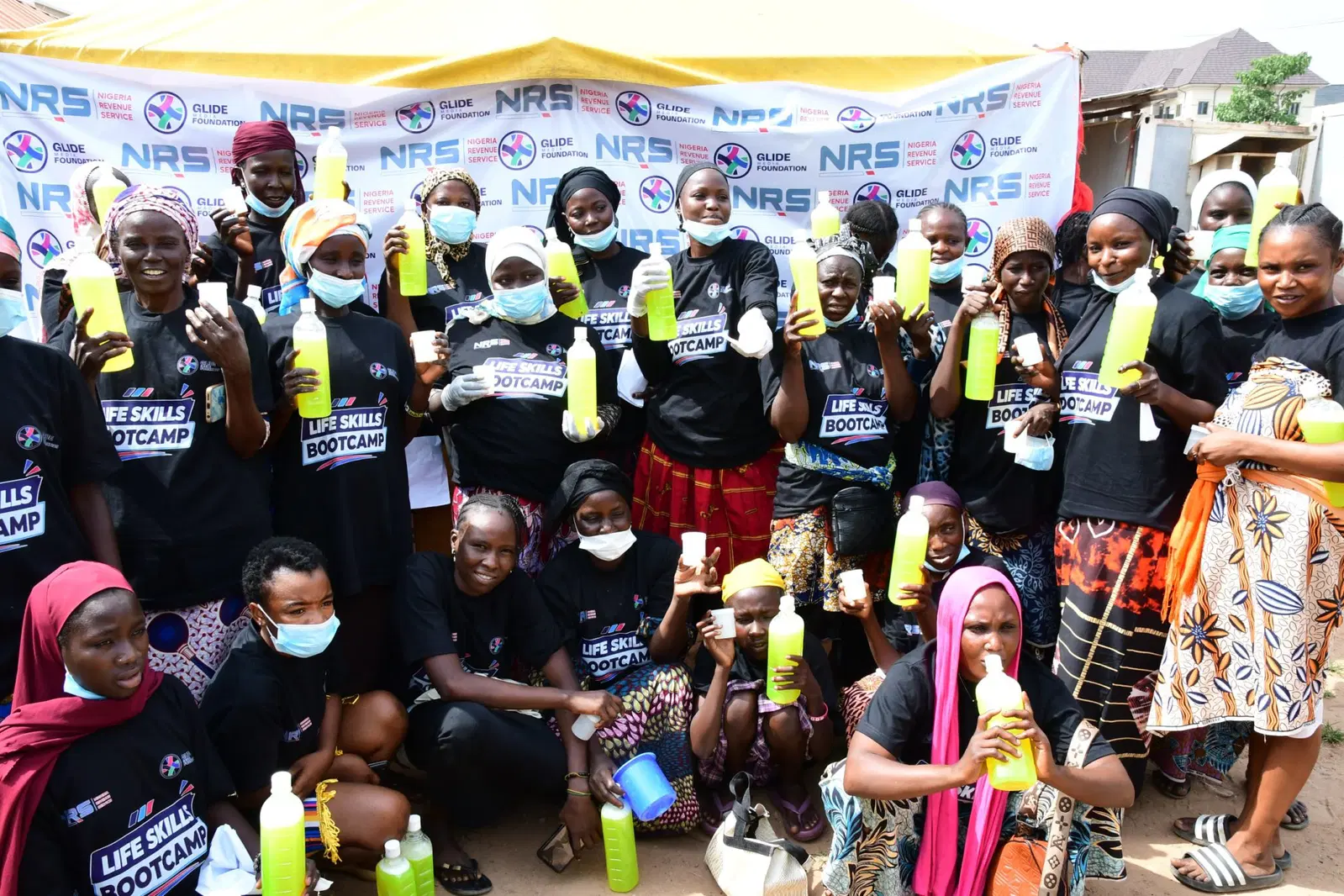
This aspiration informed the five-day Life Skills Bootcamp organised by GLIDE Media Foundation in partnership with the Nigeria Revenue Service (NRS), which provided more than 100 displaced women and girls with vocational training and start-up funding.
The programme, which culminated in a grand finale on Saturday, October 24, 2026, was designed to equip participants with practical knowledge, entrepreneurial skills and financial management techniques to help them establish small businesses and improve their livelihoods.
For the participants, the initiative offered an opportunity to explore income-generating activities that could help them support their families while navigating the economic difficulties associated with displacement.
Turning Skills into Opportunities
At the heart of the programme was the recognition that practical skills can open doors to economic opportunities, particularly for people facing difficult living conditions.
The bootcamp combined classroom-style sessions with hands-on vocational training, allowing participants to learn both the principles of running a business and the practical steps involved in producing goods for sale.
During the practical sessions, participants received training in making beaded slippers, baking, producing soap and preparing petroleum jelly.
They were divided into three groups, with specialised trainers demonstrating production techniques and supervising their activities.
Beyond learning how to make the products, participants received guidance on packaging, marketing and selling their goods. These additional skills were intended to help them understand how to turn their newly acquired abilities into viable small-scale businesses.
The provision of start-up funds at the conclusion of the programme was another important component, offering participants financial support to begin applying what they had learnt.
By combining vocational instruction with initial funding, the organisers sought to bridge the gap between acquiring skills and putting them to productive use.
Building Financial Confidence
The programme also recognised that earning money is only one part of running a successful business. Knowing how to manage income, control expenditure and save for future needs is equally important.
Consequently, the theoretical sessions covered budgeting, saving, expenditure planning and the need to keep personal finances separate from business funds.
Participants were encouraged to understand how financial decisions could affect their businesses and household welfare.
Facilitators also introduced digital financial services, including OPay and Moniepoint, highlighting their potential to support transactions and the management of small businesses.
The sessions provided an opportunity for participants already engaged in business to share their experiences, including the challenges of managing earnings and attracting customers.
Discussions also explored how social media could help entrepreneurs promote their products beyond their immediate communities and reach a wider customer base.
For aspiring business owners, these lessons offered a foundation for thinking beyond production to the practical demands of operating a business in an increasingly competitive environment.
Confidence, Parenting and Personal Development
While economic empowerment remained central to the initiative, the bootcamp also addressed personal development, decision-making, leadership and wellbeing.
Participants were encouraged to build confidence, identify achievable goals and recognise their capacity to contribute to their families and communities despite the challenges associated with displacement.
Parenting and child protection also featured prominently during the sessions.
Discussions covered positive parenting practices, children’s emotional wellbeing, school attendance and the difficulties of balancing childcare responsibilities with income-generating activities.
Facilitators emphasised the importance of supportive home environments and explained how parental behaviour could influence children’s development.
The inclusion of these subjects reflected the programme’s broader focus on helping participants navigate both their economic responsibilities and family obligations.
For women and girls managing several demands, the combination of livelihood training and personal development offered a more comprehensive approach to building resilience.
A Pathway Towards Economic Independence
GLIDE Media Foundation said the initiative was designed to equip displaced women and girls with practical skills that could support their families and reduce their dependence on external assistance.
The partnership with the NRS provided support for a programme that combined entrepreneurship, financial literacy, vocational instruction and start-up funding.
The foundation expressed hope that participants would continue developing their skills and translate the training into sustainable businesses capable of improving their economic circumstances.
However, the long-term impact of the initiative will depend partly on participants’ ability to establish businesses, attract customers and manage their earnings effectively.
Continued guidance, access to markets and opportunities to strengthen their skills could further support their efforts to build sustainable livelihoods.
For the more than 100 women and girls who participated, the bootcamp represents an opportunity to move from learning to action.
Ultimately, its success will be reflected not only in the skills acquired during the five days but also in how effectively participants use their training and start-up funds to generate income, support their families and build greater economic independence.
-
 Featured7 years ago
Lampard Names New Chelsea Manager
-
 Featured7 years ago
FG To Extends Lockdown In FCT, Lagos Ogun states For 7days
-
 Featured7 years ago
Children Custody: Court Adjourns Mike Ezuruonye, Wife’s Case To April 7
-
 Featured7 years ago
NYSC Dismisses Report Of DG’s Plan To Islamize Benue Orientation Camp
-

 Featured5 years ago
Transfer Saga: How Mikel Obi Refused to compensate me After I Linked Him Worth $4m Deal In Kuwait SC – Okafor
-
Featured7 years ago
Board urges FG to establish one-stop rehabilitation centres in 6 geopolitical zones
-

 News2 years ago
Zulu to Super Eagles B team, President Tinubu is happy with you
-
Sports4 years ago
TINUBU LAMBAST DELE MOMODU













