
Featured
NGO Trains Military Wives On Mental Health, Psychological Support in Abuja

Joel Ajayi
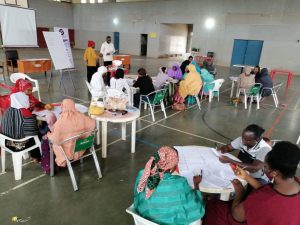
In its effort to support and equip Nigeria’s women on mental health, psychological, a non-governmental organization known as ”The Support Nest Initiative” has trained officers’ wives in Abuja to help them navigate through peculiarities of military marriages as well as life.
The 5-day training which took place inside the Lungi Barracks focuses on the mental health of the Nigerian Military wives and will enable them to become first respondents and lay counsellors in their communities.

Speaking on Friday at the end of, the awareness, the Director of the organization, Bukola Ugbuji said that objective of the training is to the mental awareness and support to a person suffering from mental health illnesses, especially service, women, and their families.
She lamented that the mental health of the military wife has been neglected and as one of the officer’s wives who know the pains and would not want others to pass through the same.
According to her, while the military has psychologists and psychiatrists to look after the men, it seems as their families are neglected. At the end of the day, there are not enough military psychologists to go round.
“We are going to set up groups and distribute fliers and notification to people across the Barracks. We will tell them to call a particular number if they need to talk. The number will be routed to the women who will then be able to offer to counsel.

“Living and caring for the family member experiencing Pos-TrumaticStress Disorder PSTD could be challenging, that is why we have compiled the list of ways to support the affected family member.”
She revealed that that the organization also holds sensitization workshops and campaigns within the barracks and military formations to raise awareness of mental health issues particularly those common within the military.
Mrs. Ugbuji, the mental health enthusiast added that the 24 women have been trained to become lay counselors who will go into their communities and offer the first line of support to members of their community.
Speaking earlier, the facilitator and Special Programmes Coordinator for ILERA Community Health Initiative, Nigeria, Yomi Oloko revealed that its programme which was funded by the African Foundation for Development, UK was aimed at supporting training on mental health, a topic which is necessary especially with the trauma and stress of the COVID-19 pandemic.
He stated that the women are trained to be lay counselors, explaining that the lay counsellors were ordinary people who want to be a helper or support people who have mental issues by listening to them and urging them to open up and talk to find their own solution to the issues they face.
“Lay counsellors are important particularly now that we had a lot of issues around depression and anxiety, especially with the COVID-19. A lot of people are worried and they need people they can talk to sometimes, they need independent or neutral people.”
One of the participants, Kauna Ottah, commended the organization for the training saying it will go a long way to help her handle people with mental health issues.
“Also, our personnel who are out there in the Northeast and Northwest might come back with trauma because of what they have experienced. The training is a welcome development because it is going to have a positive impact on our soldiers, we the spouse and our families.”



Business
Tax Applies to Profits, Not Assets, Savings, Adedeji Clarifies

….Reassures citizens no deductions from bank accounts
….Low-income earners to benefit from exemptions on food, transport
…Tax reforms focus on profits, modernisation, simpler compliance
By Joel Ajayi
The Executive Chairman of the Nigeria Revenue Service (NRS), Dr Zacch Adedeji, has sought to allay rising public concerns surrounding Nigerias recently implemented tax reforms, firmly dismissing speculation that funds held in bank accounts may be subjected to taxation.
Speaking on Tuesday during Journalists Hangout, a current affairs programme on TVC, Adedeji emphasised that neither the former tax regime nor the new legal framework empowers any authority to levy taxes on bank balances, savings, transfers or account holdings. He stressed that the countrys tax system remains fundamentally profit-based.
Whether under the old tax law or the new one, nobody has any business with your personal bank account, whether you are an individual or a company, he said.
Tax is calculated as a percentage of your profits. Assets and savings are not taxed; only profits and returns are.His remarks follow widespread rumours suggesting that the reforms, effective from 1 January 2026, would enable automatic debits from bank accounts based on transaction descriptions, balances, or transfers.
Adedeji described such claims as sheer misinformation, stating unequivocally that no law authorises tax authorities to direct banks to deduct money merely because funds are transferred or retained.
There is no law that allows anyone to go into your bank account and tax you simply because you transfer or keep money, he reiterated, adding that personal transfers, gifts, and movement of funds between accounts are not, by default, taxable events.
He further debunked suggestions that transaction narrations could trigger tax deductions, noting that no existing tax legislation – old or new – contains such provisions.Adedeji also clarified that the transition from the Federal Inland Revenue Service (FIRS), to the Nigeria Revenue Service (NRS), represents a comprehensive institutional reform rather than a mere change of nomenclature.
The overhaul, he explained, aims to modernise tax administration, simplify compliance, and enhance efficiency.
Transition provisions were embedded in the law signed in June 2025, with a January 2026 commencement date to give citizens and businesses sufficient time to adjust.Addressing anxieties surrounding the newly introduced development levy, the NRS chief stated that it does not constitute a fresh tax.
Rather, it consolidates existing earmarked taxes, such as the education tax and police trust fund levy, into a single charge. This consolidation, he noted, reduces multiplicity, eases planning for businesses, and still channels funding to education, security, and other development priorities.
Previously, we had several earmarked taxes – education tax, police trust fund and others – which made planning difficult for businesses, he explained.
With the development tax, these are consolidated into one item, simplifying compliance while still supporting those key sectors.Adedeji emphasised that the reforms were deliberately structured to protect poorer Nigerians.
He pointed out that essential goods and services absorbing the bulk of low-income expenditure, particularly food and transportation, are exempt from transactional taxes.If you consider the exemption list, about 90 per cent of the disposable income of low-income earners goes on food and transport, he said.
These items are exempted from transactional taxes.
He further disclosed that workers on lower salary bands would notice reduced tax deductions in their January payslips.Responding to calls for suspension of the new tax laws, Adedeji maintained that such demands were inconsistent with democratic principles. Suspension of law has no place in a democracy.
Once a law is passed, it becomes law, he said, warning that suspension would create a legal vacuum since the previous tax laws had already been repealed.
On criticisms reportedly raised by KPMG, he explained that government preferred constructive engagement over confrontation.
He confirmed that he had met with representatives of the firm to discuss areas of concern, saying it was natural for people to misunderstand aspects of new legislation. Feedback, he stated, remains welcome as part of ongoing implementation.He further clarified that existing tax clearance certificates remain valid and reaffirmed that withholding tax constitutes a prepaid tax, not an additional charge.
Proper filing, he said, would ensure that any withheld sums are credited against final liabilities.Adedeji added that taxation of digital asset activities applies only to realised profits, not to underlying capital. He highlighted that the reforms have eliminated minimum tax provisions that compelled payment even when businesses made losses.
Where there are losses, you do not pay tax, because tax is imposed only on profits, he said.
According to him, the overarching objective of the reforms is to harmonise Nigerias tax system, reduce manual processes, and deepen the use of technology and revenue intelligence, ultimately fostering a fairer, more transparent and efficient regime.
-
 Featured7 years ago
Lampard Names New Chelsea Manager
-
 Featured6 years ago
FG To Extends Lockdown In FCT, Lagos Ogun states For 7days
-
 Featured6 years ago
Children Custody: Court Adjourns Mike Ezuruonye, Wife’s Case To April 7
-
 Featured7 years ago
NYSC Dismisses Report Of DG’s Plan To Islamize Benue Orientation Camp
-

 Featured4 years ago
Transfer Saga: How Mikel Obi Refused to compensate me After I Linked Him Worth $4m Deal In Kuwait SC – Okafor
-
Sports3 years ago
TINUBU LAMBAST DELE MOMODU
-

 News1 year ago
Zulu to Super Eagles B team, President Tinubu is happy with you
-
Featured6 years ago
Board urges FG to establish one-stop rehabilitation centres in 6 geopolitical zones