
News
Stakeholders clamour for states to domesticate criminal justice act
Agency Reporter
Concerned stakeholders in the judicial sector have called for the domestication of the criminal justice act the every states of the federal to allow for speedy dispensation of justice.
Mr Frank Ijege, Legal Officer, TransparencIT, a Non-governmental Organisation (NGO) made this known in Abuja at a Public Policy Dialogue on Corruption Cases and Administration of Criminal Justice Act Compliance.
The dialogue was organised by TransapencIT in partnership with Trust Africa.
Ijege noted before the enactment of the act, there had been issues and challenges affecting the speedy completion of matters.
“We are here to discuss issues affecting corruption cases in Nigeria and the administration of criminal justice act.
“Prior to the enactment of this Act, we had issues and challenges affecting the speedy completion of corruption matters so with the advent of the act there are innovations to fast track cases.
” But if we can now have a situation where there is faithful implementation of the act, then the number of days cases last in the court will be reduced drastically and also we are calling for other states to also domesticate this to have their own administration of criminal justice so that cases that has been pending for so many year we can do away with them.”
Ijege also explained that judges handling criminal cases are the same judges that handles normal cases hence the need to have specialised courts to trial matters considering the fact that corruption has eaten deep into our system.
He said establishing specialised courts specifically for handling corruption cases will lead to speedy dispensation of justice.
” This judges are human beings and their diaries are very tight it is possible that they are overwhelmed with the number of cases they handle on a daily basis but if you have specialised court to trial corruption cases, it can ease their work.
“And they will be able to administer justice at the short possible time cases are brought to the court and it will be justice for the society, justice for the defendant and justice for our nation.
” In practice, we discover that a judge has an average of 10-20 cases in a day which comes up for trial but how possible is this judge able to handle this cases,” he said.
Meanwhile, Mr Henry Anoliefo, Programme Officer, Partners West Africa, Nigeria called for capacity building to criminal justice actors such as the magistrates and the justices.
Anoliefo said that majority of the judicial actors do not know what the provisions of the act is saying, hence the need for the training that will give rise to compliance of the act.
He, therefore, called for more funding as a key player in the success of compliance of the administration of criminal justice act.
Also, Mr Joshua Dada, a lawyer said that the implementation of the act was an impediment to handling corruption cases in the country.
Dada also identified lack of synergy between investigating agencies as problems in the administration of criminal justice in the country.
He further called for the appointment of more judges to handle corruption cases pending in the courts.
He, therefore, called for a committee to be set up to review the administration of the criminal justice act before prosecution in court.
NAN



News
NTAC Celebrates Seven Returnees, Applauds Contributions to Uganda’s Academic Sector
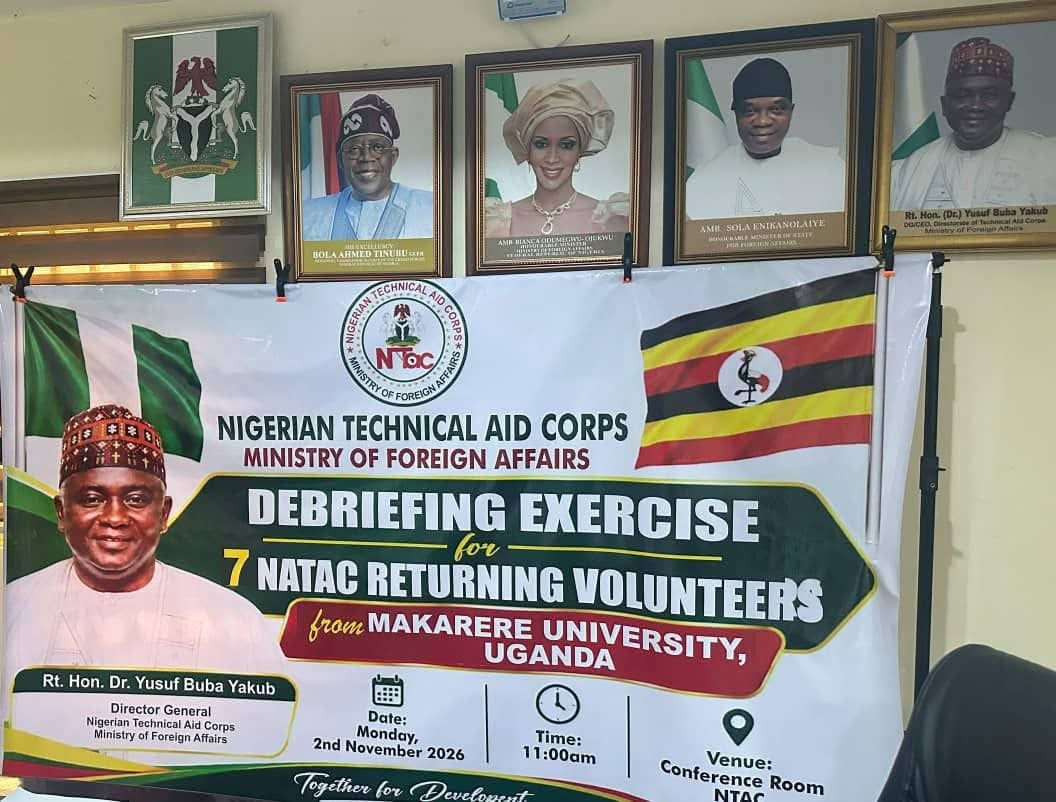
By Joel Ajayi
The Nigerian Technical Aid Corps (NTAC) has welcomed seven Nigerian volunteers who successfully completed their two-year assignments at Makerere University, Uganda, commending their dedication, professionalism and contributions to academic development and international cooperation.
The volunteers were received on Monday, November 2, 2026, during a debriefing exercise held at the NTAC Complex in Abuja, where they shared their experiences, achievements and challenges during their service under the Federal Government’s Technical Aid Corps Scheme.
In a statement issued by the Head of Information and Public Relations, NTAC, Ojo Adetoun Olubunmi, the exercise was designed to assess the volunteers’ performance, review their experiences and explore ways of translating the knowledge and expertise acquired abroad into meaningful contributions to their respective institutions and Nigeria.
Speaking on behalf of the Director-General and Chief Executive Officer of NTAC, Rt. Hon. Yusuf Buba Yakub, the Assistant Director, Programme 11, Mr Felix Obidi, congratulated the returnees on the successful completion of their assignments.
Obidi commended their commitment, professional conduct and exemplary service, noting that their contributions had helped project Nigeria positively in the international community.
Describing the returnees as veterans of the Technical Aid Corps Scheme, he urged them to deploy the knowledge, skills and international exposure acquired at Makerere University to improve their institutions and contribute to national development.
He likened their international experience to that of fishes that had explored wider waters, stressing that their exposure should distinguish them professionally and intellectually.
“You are no longer just returning volunteers; you are veterans of the Nigerian Technical Aid Corps. We expect you to bring back the knowledge and experience you have acquired at Makerere University and share them with your respective institutions. You are foreign fishes, and we expect more from you,” he said.
Obidi assured the volunteers that their expertise would continue to be valuable to NTAC and the country, while appreciating President Bola Ahmed Tinubu for his sustained support for the Scheme.
He also acknowledged the contributions of the Minister of Foreign Affairs, Ambassador Bianca Odumegwu-Ojukwu, and the Minister of State for Foreign Affairs, Ambassador Sola Enikanolaiye, towards sustaining the programme.
Similarly, the representative of the Director of Programmes, Senior Counsellor Mrs Hauwa Arabu Mustafa, congratulated the returnees and commended their contributions to academic development and the promotion of South-South cooperation.
Speaking on behalf of the returning volunteers, their team leader, Prof. Abdul Anakobe Isah, expressed gratitude to the Federal Government and NTAC for providing them with the opportunity to serve at Makerere University.
He described the assignment as a rewarding professional experience and praised the university’s management and staff for their hospitality, cooperation, professional support and provision of adequate teaching and learning facilities.
However, he identified some accommodation-related challenges encountered during their two-year assignment.
One of the returning volunteers, Prof. Alo Oluwaseun Olubisi, highlighted her achievements, including securing a Research and Innovation Grant at Makerere University.
She explained that although she initially doubted her eligibility because she was a Nigerian, encouragement from her Head of Department prompted her to apply, eventually leading to a successful grant award.
Olubisi said the assignment significantly improved her teaching methodologies, lecture preparation and delivery while providing opportunities for professional development and research collaboration.
She also disclosed that she facilitated a Memorandum of Understanding between Makerere University and her home institution in Nigeria, noting that the partnership had reached an advanced stage.
The debriefing provided an opportunity for the returning volunteers to present their experiences, achievements, challenges and recommendations, which NTAC said would serve as valuable input towards improving the implementation of the Technical Aid Corps Scheme.
The event also featured the presentation of certificates of service to the returning volunteers in recognition of their successful completion of the assignment.
Established in 1987, the Nigerian Technical Aid Corps is a key instrument of Nigeria’s foreign policy and South-South cooperation, deploying skilled Nigerian professionals to countries across Africa, the Caribbean and the Pacific to provide technical assistance, promote knowledge exchange and strengthen international partnerships.
With more than 10,000 Nigerian professionals deployed to beneficiary countries over the years, the Scheme continues to demonstrate Nigeria’s commitment to human capital development, international cooperation and the use of professional expertise as an instrument of development diplomacy.
The successful completion of the Makerere University assignment by the seven volunteers further underscores the importance of the Scheme in fostering professional exchange, strengthening institutional partnerships and ensuring that international exposure translates into tangible benefits for Nigeria’s development.
-
 Featured7 years ago
Lampard Names New Chelsea Manager
-
 Featured7 years ago
FG To Extends Lockdown In FCT, Lagos Ogun states For 7days
-
 Featured7 years ago
Children Custody: Court Adjourns Mike Ezuruonye, Wife’s Case To April 7
-
 Featured7 years ago
NYSC Dismisses Report Of DG’s Plan To Islamize Benue Orientation Camp
-

 Featured5 years ago
Transfer Saga: How Mikel Obi Refused to compensate me After I Linked Him Worth $4m Deal In Kuwait SC – Okafor
-
Featured7 years ago
Board urges FG to establish one-stop rehabilitation centres in 6 geopolitical zones
-
Sports4 years ago
TINUBU LAMBAST DELE MOMODU
-

 News2 years ago
Zulu to Super Eagles B team, President Tinubu is happy with you













