
Foreign news
Xi Jinping: Next five years ‘crucial time’ for Hong Kong to make breakthroughs
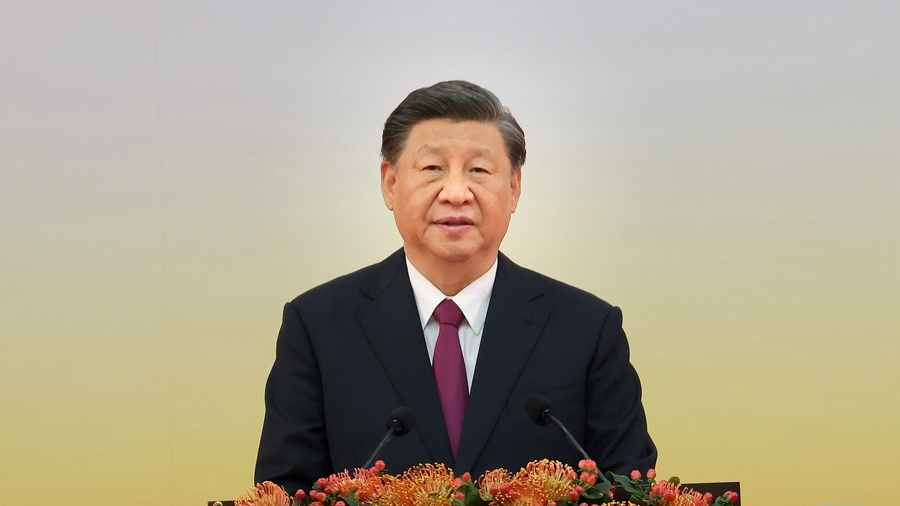
The practice of “One Country, Two Systems” in Hong Kong has achieved accomplishments “recognized worldwide,” Chinese President Xi Jinping said on a visit to the Hong Kong Special Administrative Region (HKSAR) on Friday.
Xi made the remarks at a meeting celebrating the 25th anniversary of Hong Kong’s return to China and the inaugural ceremony of the sixth-term government of the HKSAR.
Xi said Hong Kong’s return opened a new epoch in its history during which it has made irreplaceable contributions to the miracle of long-term, steady and fast economic development of the motherland.
Hong Kong has become an integral part of the country’s overall development and actively aligned with national development strategies, the president said. It has continued to maintain the strengths of being highly free and open and compatible with international rules, he added.
Hong Kong has played an important role in advancing the new paradigm of China’s opening up on a larger scale, across more areas and in greater depth, he said.
The next five years will be crucial for Hong Kong to achieve breakthroughs, Xi said, calling for joint efforts from the new HKSAR government and all social sectors to improve governance, strengthen growth drivers, address difficulties in people’s lives, and safeguard harmony and stability.
Full, faithful implementation of ‘One Country, Two Systems’
Xi stressed the need to fully and faithfully implement the “One Country, Two Systems” policy.
Upholding national sovereignty together with security and development interests are paramount in the policy, he said. On the basis of this prerequisite, Hong Kong and Macao should maintain their capitalist system over the long run and enjoy a high degree of autonomy, he added.
Calling on Hong Kong to keep strengthening the momentum of development, Xi said the central government fully supports the HKSAR in aligning with national development strategies, developing more extensive and closer exchanges and cooperation with the world, advancing reforms in an active and prudent manner, and fully unleashing the enormous creativity and development vitality of Hong Kong society.
John Lee was sworn in as the sixth-term chief executive of the HKSAR at a ceremony overseen by President Xi.
In his inauguration speech, Lee said Hong Kong has encountered various challenges in the last 25 years, including the global financial crisis, social unrest and the COVID-19 pandemic, but has overcome all of them, thanks to the “resilience and strong will” of the people, as well as unique advantages under the “One Country, Two Systems” policy.
He vowed to adopt a “results-oriented approach” to tackle Hong Kong’s long-term issues, such as housing and land supply, whilst bolstering the city’s overall competitiveness in its traditional role as a global financial hub and as an emerging center for innovation and technology, as well as arts and cultural exchange.
(CGTN’s Huang Fei contributed to the story.)



Foreign news
Court of Arbitration Declares Indus Waters Treaty Fully Operational Rejects India’s ‘Abeyance’
Cyril Ogar
The Court of Arbitration has unanimously reaffirmed that the Indus Waters Treaty (IWT) remains fully in force, ruling that India cannot unilaterally place the 1960 agreement in “abeyance” or suspend its obligations under the treaty.
The decision represents a significant legal development in the longstanding dispute between India and Pakistan over the management and use of the Indus river system.
The Court’s finding addresses a fundamental issue at the heart of the dispute: whether either party can unilaterally suspend the treaty outside the legal framework agreed by both countries.
In its unanimous determination, the Court made clear that the IWT continues to bind both India and Pakistan and that its obligations cannot be set aside through a unilateral political declaration.
The ruling means India remains subject to the treaty provisions governing the use of the Western Rivers, including requirements relating to the design and operation of hydroelectric projects, as well as the dispute-resolution mechanisms established under the agreement.
The Court has also ordered interim measures concerning the Ratle Hydroelectric Plant, restricting specified construction activities while the broader dispute remains under consideration.
The measures are aimed at preserving the effectiveness of the arbitration process and preventing developments that could prejudice the outcome of the proceedings.
For Pakistan, the decision represents significant legal validation of its longstanding position that the IWT is a binding international agreement and contains no provision allowing either party to unilaterally place it in abeyance.
Pakistan has consistently maintained that disagreements over the treaty should be addressed through the institutional mechanisms established by the agreement, rather than through unilateral action.
The IWT provides a structured framework for resolving disputes through mechanisms including the Permanent Indus Commission, Neutral Expert and Court of Arbitration processes.
The latest ruling therefore reinforces the principle that treaty obligations cannot simply be disregarded because of deteriorating political relations between signatories.
The significance of the decision extends beyond the India-Pakistan dispute. It underscores the broader international-law principle that agreements governing shared rivers and other transboundary resources must be respected and disputes resolved through established legal and institutional channels.
The Indus river system supports agriculture, livelihoods, food security and communities across the region, making the stability of the treaty particularly important.
The ruling also highlights the distinction between seeking to amend an international agreement through mutually agreed procedures and attempting to alter its obligations unilaterally.
The IWT has endured wars, prolonged diplomatic tensions and periods of limited bilateral engagement. Its continued operation demonstrates the importance of rules-based mechanisms in managing shared resources when relations between neighbouring states become strained.
For Pakistan, the outcome provides an opportunity to frame the decision not merely as a bilateral legal victory, but as an affirmation of international law, treaty compliance and peaceful dispute resolution.
The central message from the ruling is clear: the Indus Waters Treaty remains in force, its obligations continue to bind both parties, and disputes concerning shared waters must be addressed through the legal mechanisms agreed by India and Pakistan.
-
 Featured7 years ago
Lampard Names New Chelsea Manager
-
 Featured6 years ago
FG To Extends Lockdown In FCT, Lagos Ogun states For 7days
-
 Featured7 years ago
Children Custody: Court Adjourns Mike Ezuruonye, Wife’s Case To April 7
-
 Featured7 years ago
NYSC Dismisses Report Of DG’s Plan To Islamize Benue Orientation Camp
-

 Featured5 years ago
Transfer Saga: How Mikel Obi Refused to compensate me After I Linked Him Worth $4m Deal In Kuwait SC – Okafor
-
Featured7 years ago
Board urges FG to establish one-stop rehabilitation centres in 6 geopolitical zones
-
Sports4 years ago
TINUBU LAMBAST DELE MOMODU
-

 News2 years ago
Zulu to Super Eagles B team, President Tinubu is happy with you