
Foreign news
China Says To Put Major Efforts In Domestic Market, While Actively Seeking Out Overseas Opportunities
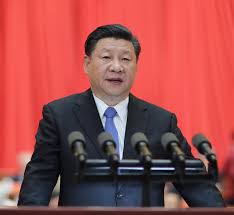
In a world rocked by the COVID-19 pandemic and escalating tensions with the United States, China has got itself well prepared — with a new economic model called “dual circulation” that is expected to shape the country’s blueprint for the next five years.
The new pattern, “dual circulation”, also known as “double development dynamic,” refers to the two economic circles: trade at home and abroad, but this time with greater emphasis on the domestic market. Hyping discussions immediately prompt suggestions that the Chinese economy would “turn inward,” as it is argued that focusing on trade at home means “closing doors” to the outside world.

Yet to Beijing, opening its door wide seems like a long-term plan that it’s not looking to give up. On Tuesday, Chinese President Xi Jinping told the 12th BRICS summit that China will more “actively integrate into the global market”. Instead of shutting its door to opening-up, China will embrace the world with more open arms, President Xi noted.
BRICS is the acronym for an emerging-market bloc that groups Brazil, Russia, India, China, and South Africa. Tuesday’s meeting was hosted by Russia, which holds the rotating BRICS presidency this year.
China will redouble its efforts to expand domestic demand, deepen reform in all aspects, and promote innovation in science and technology to add impetus to its economic growth, he added.
“The strengthening of internal circulation has no contradiction with China’s policy of opening-up,” commented Prof. Gao Liankui of EU Business School in an opinion piece for the Global Times. “The new development pattern … was rolled out based on the objective development of the Chinese economy, which has seen industrial upgrading and an expansion of the domestic market.”
“Along with technological development, an economic entity will see its comparative advantages change, leading to a certain degree of import substitution. It’s not China’s unique path,” Prof. Gao said in the piece.
Also at the BRICS meeting, President Xi highlighted the need for international solidarity in the fight against the coronavirus. “We need to overcome differences and prejudice with unity and rationality and forge the greatest synergy in the battle against the virus,” he said.
China’s carbon neutrality commitment
Also at the BRICS meeting, Xi doubled down on the country’s commitment to achieving carbon neutrality before 2060. That goal, according to experts, would require Beijing to achieve near-zero emissions by 2050.
China will scale up its nationally determined contributions and strive to peak carbon dioxide emissions by 2030, he vowed, “You can count on China to keep its promise.”
“To achieve carbon neutrality by 2060 requires a huge transformation in all aspects of the social, economic, energy, and technological systems,” He Jiankun, vice-chairperson of the National Committee of Experts on Climate Change, told Xinhua, meaning new energy and renewable energy will be topped as the mainstay.
Official data shows that China’s emissions of carbon dioxide in 2018 were 45.8 percent lower than that of 2005, which means that the country had met its emission reduction target two years ahead of schedule.
In addition, the government has sorted out ways to promote “green development”. China has promoted carbon emissions trading in seven of its provinces and cities — including Beijing and Shanghai — since 2011 to explore market-based mechanisms to control greenhouse gas emissions.
China is ready to fulfill its due international responsibilities commensurate with its level of development, Xi said at the Tuesday meeting.
Building BRICS partnership on new industrial revolution
With respect to the BRICS partnership, Xi pointed out that China is willing to work with other BRICS members to accelerate building a BRICS partnership on the new industrial revolution.
Specifically, China will set up an innovation center for such a partnership in the city of Xiamen, southeast China’s Fujian Province, the Chinese president announced at the meeting. The innovation center will facilitate cooperation in fields including policy coordination, personnel training and project development, according to President Xi.
Established in 2009, the BRICS group was set up to establish an equitable, democratic, and multi-polar world order, while helping to shape a stable, predictable, and more diversified international monetary system.
“BRICS serves as an antidote to the G7 and other U.S.-dominated institutions,” pointed out London based political commentator Freddie Reidy. “This (its establishment) was interpreted as the need to find a new global reserve currency, consequently leading to an immediate slide in the value of the dollar, demonstrating the considerable influence of the group.”
President Xi also called on BRICS countries to hold the banner of multilateralism high, safeguard the purposes and principles of the UN Charter and the international order underpinned by international law.
People’s welfare should always be kept close to heart, he stressed in his speech, also urging the bloc to pursue the vision of a community with a shared future for mankind.
At present, the world is caught between the most serious pandemic in the past century and momentous changes never seen in the last one hundred years, Xi said, referring to the COVID-19 pandemic that has plunged the world into the worst recession since the Great Depression in the 1930s.
“Despite all this, we remain convinced that the theme of our times — peace and development — has not changed, and that the trend toward multipolarity and economic globalization cannot be turned around,” he said.



Foreign news
Algeria’s Glorious Revolution: Embassy Marks 72nd Anniversary in Abuja
Joel Ajayi
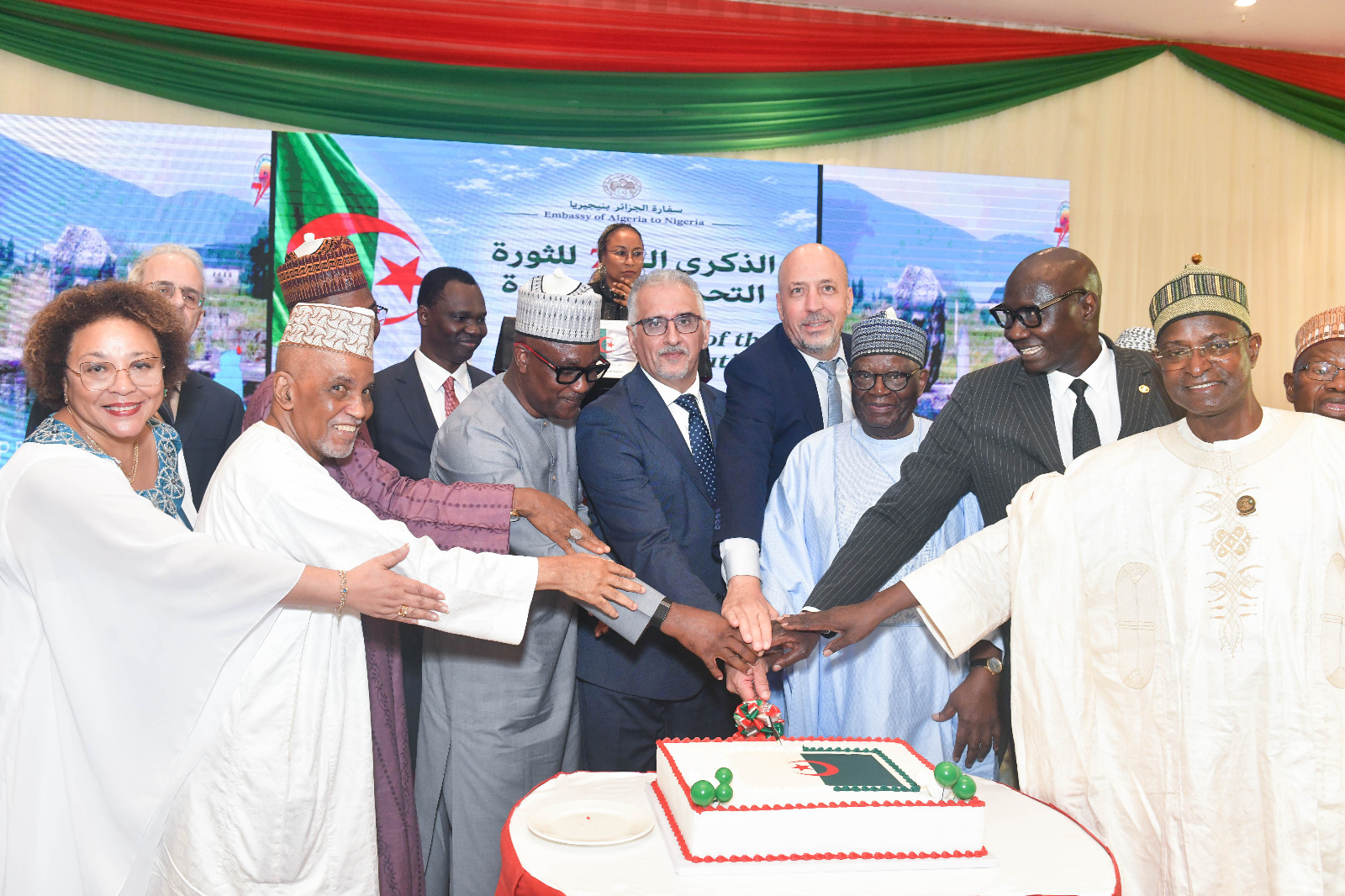
The Embassy of Algeria in Nigeria has commemorated the 72nd anniversary of the country’s Glorious Revolution of November 1, 1954, with a reception in Abuja, highlighting Algeria’s liberation struggle and strengthening diplomatic relations with Nigeria.
The event, held on November 9, 2026, at Continental Suites Hotel, attracted prominent personalities, including the Speaker of the House of Representatives, Dr Tajudeen Abbas, members of the Federal Government, senior government officials, heads of diplomatic missions and other friends of Algeria.
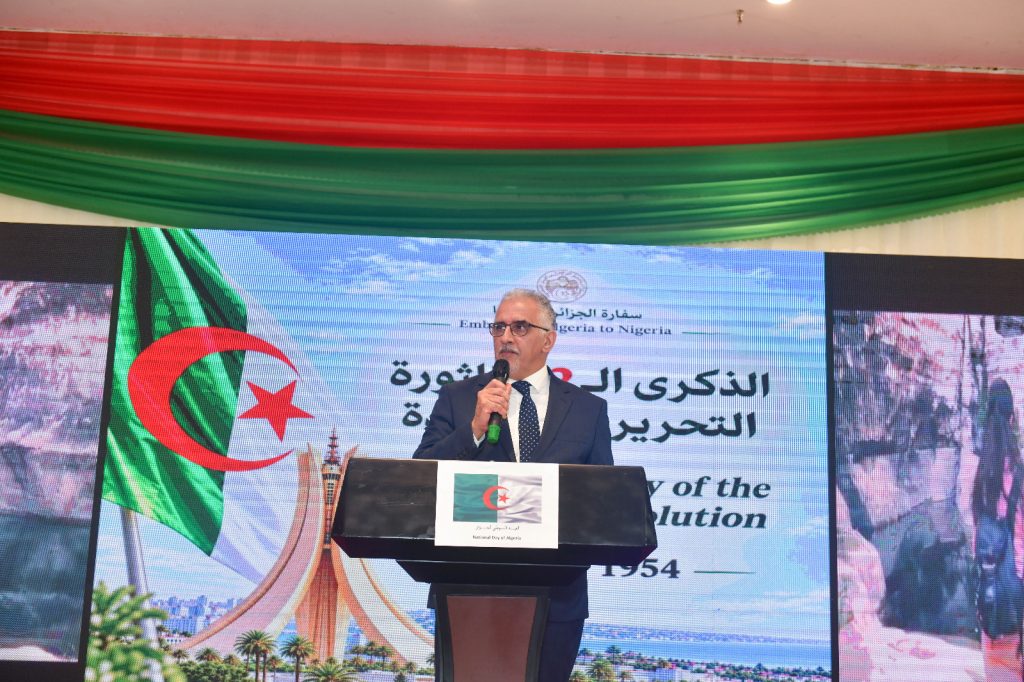
Speaking at the reception, Algeria’s Ambassador to Nigeria, Hocine Mezoued, welcomed guests and paid tribute to the country’s freedom fighters who sacrificed their lives during the struggle for independence.
He described the November 1, 1954 revolution as the foundation of modern Algeria, noting that the sacrifices of the nation’s martyrs made it possible for the country to reclaim its sovereignty.
On Algeria’s development agenda, Mezoued said President Abdelmadjid Tebboune’s administration had continued to pursue economic reforms, diversification and national development under its New Algeria vision.
He noted that the country was recording progress in non-hydrocarbon exports, while improvements in the business environment had boosted investor confidence and attracted significant foreign investments.
On foreign policy, the ambassador reaffirmed Algeria’s commitment to non-interference, respect for national sovereignty, peaceful conflict resolution and the right of peoples to self-determination.
Addressing security challenges in the Sahel, he stressed that lasting peace could not be achieved through military measures alone, insisting that economic development, inclusive dialogue and peaceful resolution of disputes remained essential.
Turning to Nigeria-Algeria relations, Mezoued described the partnership as one founded on shared values and the commitment of both countries’ leaders to advancing African development.
He identified the Trans-Saharan Highway, Trans-Saharan Gas Pipeline and Trans-Saharan Fibre Optic Backbone as major strategic projects receiving attention from both countries.
The ambassador also disclosed that Algeria had continued to provide scholarships to Nigerian students to strengthen human capital development and capacity building.
He further announced that Air Algérie expanded its Nigerian operations on October 26, 2026, with the introduction of two weekly flights to Lagos, expressing confidence that the service would boost trade and tourism.
Looking ahead, Mezoued said 2027 would offer fresh opportunities to deepen bilateral cooperation, particularly through the fifth Joint High Bi-National Commission scheduled to hold in Abuja.
He expressed optimism that the meeting would provide an opportunity to assess existing partnerships, identify new areas of cooperation and move Nigeria-Algeria relations towards a more practical and results-driven phase.
-
 Featured7 years ago
Lampard Names New Chelsea Manager
-
 Featured7 years ago
FG To Extends Lockdown In FCT, Lagos Ogun states For 7days
-
 Featured7 years ago
Children Custody: Court Adjourns Mike Ezuruonye, Wife’s Case To April 7
-
 Featured7 years ago
NYSC Dismisses Report Of DG’s Plan To Islamize Benue Orientation Camp
-

 Featured5 years ago
Transfer Saga: How Mikel Obi Refused to compensate me After I Linked Him Worth $4m Deal In Kuwait SC – Okafor
-
Featured7 years ago
Board urges FG to establish one-stop rehabilitation centres in 6 geopolitical zones
-

 News2 years ago
Zulu to Super Eagles B team, President Tinubu is happy with you
-
Sports4 years ago
TINUBU LAMBAST DELE MOMODU













