
Foreign news
How the U.S.-Danish scandal reveals the hypocrisy of the ‘Clean Network’
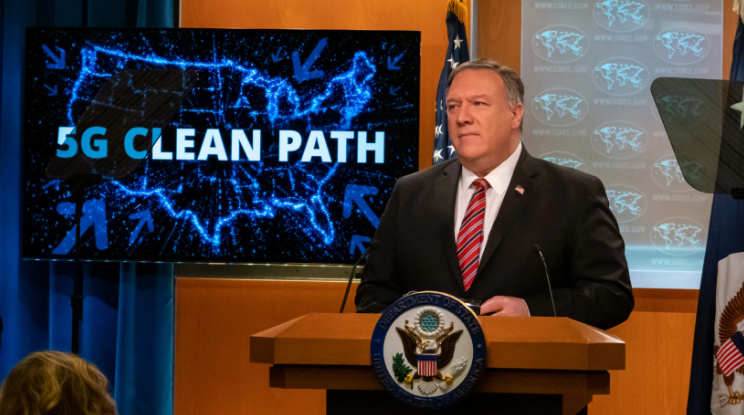
Editor’s note: Tom Fowdy is a British political and international relations analyst and a graduate of Durham and Oxford universities. He writes on topics pertaining to China, the DPRK, Britain, and the U.S. The article reflects the author’s opinions, and not necessarily the views of CGTN.
This week Denmark’s Public Broadcaster, the DR, published a series of revelations that the United States National Security Agency (NSA) coordinated with the country’s intelligence services to spy on Denmark’s government itself, including their financial and foreign ministries, as well as a number of European defense firms, in order to obtain information on the country’s fighter acquisition program and subsequently gain an advantage in selling the country Lockheed Martin F-35s instead of them purchasing Eurofighters.
The report states that the U.S. was able to tap into the country’s telecommunications networks via fiber optic cables to do so.
This is a staggering irony and mammoth scale hypocrisy from the country who preaches to others “the clean network” fears of espionage and reveals in tandem, what the American scheme to exclude Huawei is in fact really all about: the uncontested supremacy of U.S. global surveillance programs which are subsequently used to promote the interests of the military-industrial complex.
This is not a new or standalone revelation, but part of a longstanding trend by Washington which has persistently utilized such activities for commercial gain and intellectual property theft.
The anti-Huawei campaign is thus little more than a deflection for what the U.S. itself does, and they didn’t need 5G to do so.
Over the past two years, the U.S. has waged a phenomenally aggressive campaign to oust Huawei from the next-generation telecommunications networks of western countries. In doing so, it has been claimed that the Chinese company has ties to the government which subsequently allows those networks to be used for espionage.
Despite the fact that evidence of these allegations is scant, and has never been proven beyond “guilt by association” arguments, the Western mainstream media has largely taken this narrative at face value and has seldom scrutinized it.
This has created a false binary assumption that China is the “espionage threat” and the U.S. as an allied country, would never abuse technology for malign purposes.
This week’s revelations tell a different story. Here is an out in the open example as to how the United States has abused its intelligence-sharing agreements with other countries, in order to undermine that country itself for its commercial gain.
Chief to the benefactors was the military-industrial complex, which might be noted have funded a number of think tanks espousing anti-Huawei propaganda, and the losers?
Europe’s own defense industry. This is not the first time U.S. surveillance has done this.
In 1994, the U.S. intelligence sabotaged a $6-billion-deal between European firm Airbus and Saudi Arabia, so that Boeing could win it instead, and in the same year, also undermined the French company Thompson-Alcatel in Brazil so that a $1.3 billion contract could be given to Raytheon. Such agreements have also been used to steal intellectual property from the German industry.
This should reveal the superficiality of the anti-Huawei argument. This isn’t about security as much as it is about American supremacy and uncontested monopoly, in both the strategic and corporate spheres.
The Denmark story shows how the United States is cooperating with the intelligence agencies of allied countries in order to advance US interests, even acting against that country itself, and to do so requires that they “politically control” or have “access” to the telecommunications networks in a preferential way, with the U.S having also infiltrated encryption firms in the west as the Washington Post revealed in February.
Huawei however, poses a challenge on the political premise that they do not control it, and therefore such equipment is harder to be co-opted for espionage.
In this case, what might be known as “the clean network” is a snake oil sham being espoused by the United States which glosses over the inconvenient reality that the data of Europeans is not safe or private with Washington as a “good ally” as Pompeo misleadingly presents it, but that they are actively utilizing their monopoly over intelligence and pacts with respective countries to undermine European interests on behest of the military-industrial complex.
Huawei is not the threat and it never was, this is why such countries did not in fact take the American arguments seriously until they were coerced into doing so, the United Kingdom being the most obvious example. Rather, it stands in the way of uncontested American monopoly and profit.
Thus there is no “clean network”, only American interests and double standards. What it accuses a Chinese firm of groundlessly doing, is in fact a reflection of what itself has been doing all along.



Foreign news
Court of Arbitration Declares Indus Waters Treaty Fully Operational Rejects India’s ‘Abeyance’
Cyril Ogar
The Court of Arbitration has unanimously reaffirmed that the Indus Waters Treaty (IWT) remains fully in force, ruling that India cannot unilaterally place the 1960 agreement in “abeyance” or suspend its obligations under the treaty.
The decision represents a significant legal development in the longstanding dispute between India and Pakistan over the management and use of the Indus river system.
The Court’s finding addresses a fundamental issue at the heart of the dispute: whether either party can unilaterally suspend the treaty outside the legal framework agreed by both countries.
In its unanimous determination, the Court made clear that the IWT continues to bind both India and Pakistan and that its obligations cannot be set aside through a unilateral political declaration.
The ruling means India remains subject to the treaty provisions governing the use of the Western Rivers, including requirements relating to the design and operation of hydroelectric projects, as well as the dispute-resolution mechanisms established under the agreement.
The Court has also ordered interim measures concerning the Ratle Hydroelectric Plant, restricting specified construction activities while the broader dispute remains under consideration.
The measures are aimed at preserving the effectiveness of the arbitration process and preventing developments that could prejudice the outcome of the proceedings.
For Pakistan, the decision represents significant legal validation of its longstanding position that the IWT is a binding international agreement and contains no provision allowing either party to unilaterally place it in abeyance.
Pakistan has consistently maintained that disagreements over the treaty should be addressed through the institutional mechanisms established by the agreement, rather than through unilateral action.
The IWT provides a structured framework for resolving disputes through mechanisms including the Permanent Indus Commission, Neutral Expert and Court of Arbitration processes.
The latest ruling therefore reinforces the principle that treaty obligations cannot simply be disregarded because of deteriorating political relations between signatories.
The significance of the decision extends beyond the India-Pakistan dispute. It underscores the broader international-law principle that agreements governing shared rivers and other transboundary resources must be respected and disputes resolved through established legal and institutional channels.
The Indus river system supports agriculture, livelihoods, food security and communities across the region, making the stability of the treaty particularly important.
The ruling also highlights the distinction between seeking to amend an international agreement through mutually agreed procedures and attempting to alter its obligations unilaterally.
The IWT has endured wars, prolonged diplomatic tensions and periods of limited bilateral engagement. Its continued operation demonstrates the importance of rules-based mechanisms in managing shared resources when relations between neighbouring states become strained.
For Pakistan, the outcome provides an opportunity to frame the decision not merely as a bilateral legal victory, but as an affirmation of international law, treaty compliance and peaceful dispute resolution.
The central message from the ruling is clear: the Indus Waters Treaty remains in force, its obligations continue to bind both parties, and disputes concerning shared waters must be addressed through the legal mechanisms agreed by India and Pakistan.
-
 Featured7 years ago
Lampard Names New Chelsea Manager
-
 Featured7 years ago
FG To Extends Lockdown In FCT, Lagos Ogun states For 7days
-
 Featured7 years ago
Children Custody: Court Adjourns Mike Ezuruonye, Wife’s Case To April 7
-
 Featured7 years ago
NYSC Dismisses Report Of DG’s Plan To Islamize Benue Orientation Camp
-

 Featured5 years ago
Transfer Saga: How Mikel Obi Refused to compensate me After I Linked Him Worth $4m Deal In Kuwait SC – Okafor
-
Featured7 years ago
Board urges FG to establish one-stop rehabilitation centres in 6 geopolitical zones
-
Sports4 years ago
TINUBU LAMBAST DELE MOMODU
-

 News2 years ago
Zulu to Super Eagles B team, President Tinubu is happy with you